Do Blinds and Shutters Really Reduce Noise? An Honest Guide for East London Homes
If you live along the A13, the A406 North Circular, the A12 near Stratford, or under a flight path into London City Airport, you have probably wondered whether new blinds or shutters would take the edge off the noise. The honest answer is: some window coverings genuinely help a little, none of them soundproof a room, and the products that get talked up the most online, like aluminium Venetian blinds, are usually the weakest choice for this specific job.
Quick answer: the blinds and shutters most likely to reduce the traffic noise you hear indoors are heavier, denser and better sealed against the window frame. Full height shutters and lined Roman blinds fitted to a snug, made-to-measure size do the most out of the products London Blinds 4U supplies. Thin, single-layer aluminium Venetian blinds do the least, despite a persistent myth that aluminium is naturally good at blocking sound. None of these products replace secondary glazing or acoustic double glazing if traffic noise is a serious problem.
Key takeaways
- Mass and a snug, gap-free fit matter more than the material a blind is made from. A well-fitted, heavier product beats a loosely hung, lightweight one every time.
- Full height shutters, being solid panels rather than folded fabric, are generally the best-performing option in the approved range for taking the edge off traffic noise.
- A lined Roman blind, especially one with an interlining or blackout lining, adds meaningful weight and a still air gap behind it, both of which help.
- Aluminium Venetian blinds are thin, light, and full of small gaps between slats. They are one of the weakest options here, not the strongest, despite what some blinds retailers claim.
- No blind or shutter sold anywhere will genuinely soundproof a room. If traffic noise is a real problem, secondary glazing or acoustic glazing is the only measure with a track record of doing that.
What Actually Blocks Sound at a Window
Sound travels through a window as vibration, first through the glass, then across any gap around the frame, and finally through whatever is hanging in front of it. Two things determine how much a blind or shutter can interrupt that path: how much mass it has, and how completely it seals the opening.
This comes from a basic and well-established principle in acoustics, sometimes called the mass law: a heavier, denser barrier blocks more airborne sound than a lighter one of the same size. It is the same reason a solid fire door feels and sounds different from a hollow one, and it is why a thick curtain feels like it is doing more than a net curtain, because it is.
The second factor, sealing, matters just as much. A window covering that stops short of the frame, or hangs with visible gaps at the sides, lets sound pass straight through the gap rather than through the material. This is precisely why a recess-fit blind measured slightly too small will always underperform an outside-recess fit that overlaps the frame on all sides. It is the same measuring principle covered in our guide to measuring for blinds, and it applies to noise just as much as it applies to light leak on a bedroom blackout blind.
What none of this changes is the glass itself, or the wall around it. A single pane of standard glazing is the weakest part of most East London homes when it comes to outside noise, particularly in the Victorian and Edwardian terraces common across Leyton, Walthamstow, Forest Gate and parts of Ilford, where original sash windows are still common. A blind or shutter sits in front of that glass. It cannot change what the glass itself does.
Which Blinds Cut the Most Noise? Roller, Roman, Vertical and Venetian Compared
Within the range London Blinds 4U supplies, performance for noise reduction breaks down roughly as follows, based on the mass and sealing principles above rather than any laboratory testing of these specific products, which we do not have and would not claim to have.
Roman blinds, particularly with a blackout or interlining fitted, are one of the better fabric options. A lined Roman blind typically carries a heavier interlining layer behind the visible fabric, which adds real mass compared with a single-layer roller fabric, and folds down into soft pleats that sit close to the glass rather than a taut, drum-tight sheet. That combination of added weight and a less rigid surface gives it a small but genuine edge over a single-layer blind of similar size.
Roller blinds made from a thicker, denser fabric perform reasonably well too, especially blackout or thermal-backed fabrics, which carry more mass than a light, translucent screen fabric. A roller blind fitted with side channels, the same fitting used to close the light-leak gap on a bedroom blackout blind, also closes the sound-leak gap at the same time, for the same reason.
Vertical blinds sit somewhere in the middle. Wide fabric louvres carry more material than narrow slats, and a well-fitted vertical blind across a large window or patio door, where there is more surface area to work with, can make a noticeable difference simply because there is more blind between you and the window than with a smaller product.
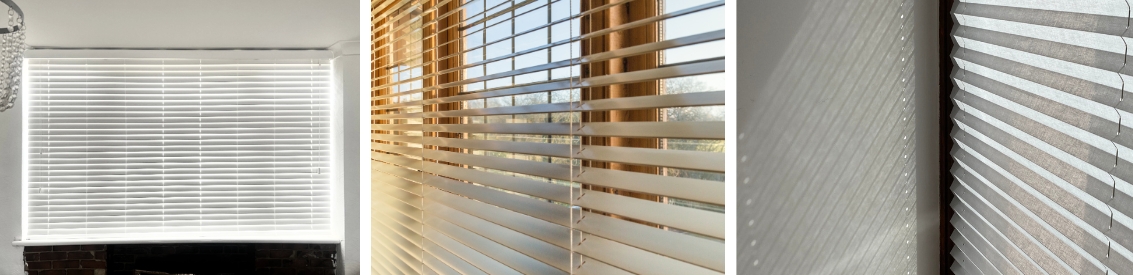
Venetian blinds and wood Venetian blinds perform moderately. Timber slats simply have more mass than aluminium ones, so a wood Venetian blind outperforms an aluminium Venetian blind of the same size. But every Venetian blind, wood or metal, is made of individual slats with small gaps between them when closed, which is a structural weak point for sound in a way that a single continuous fabric or panel is not.
Do Shutters Reduce Noise Better Than Blinds?
Of everything London Blinds 4U supplies, shutters are the strongest performer for taking the edge off outside noise, and it is not close. A shutter panel, whether full height, tier on tier, cafe style or sliding, is a rigid, solid frame filled with louvres, sitting inside a hinged surround that is fixed directly to the window reveal. That gives it two advantages a hanging blind cannot match: a solid frame that closes properly against the window opening on all four sides, and a panel with far more physical mass than a folded fabric or a set of aluminium slats.
For our full breakdown of how the different shutter styles compare on light control, privacy and cost, see Full Height vs Tier on Tier Shutters: What’s the Difference. For noise specifically, a full height shutter, being one continuous panel rather than two stacked sections, has the fewest joins and gaps of any style in the range, which is exactly what matters for sound as well as for light and privacy.
None of this makes a shutter a soundproofing product. It performs better than a blind for the same job, not in a different league entirely.
The Aluminium Venetian Blind Myth
A claim that turns up on several UK blinds websites is that aluminium Venetian blinds are good for noise reduction because “aluminium foil is used in soundproofing.” This is worth addressing directly, because it is misleading in a way that could send you towards the wrong product.
Aluminium is used in some acoustic products, but as a thin foil layer bonded to a much heavier mass-loaded barrier material, forming part of a multi-layer damping system built for that exact purpose. A single sheet of aluminium foil on its own does very little to stop sound, and a set of thin, lightweight aluminium slats with air gaps between every one of them behaves nothing like that engineered barrier. If anything, aluminium Venetian blinds are one of the lightest, most gap-prone products in the range covered here, which by the mass and sealing principles above makes them one of the weaker choices for noise, not one of the stronger ones. They remain an excellent choice for kitchens, bathrooms and offices where moisture resistance, wipeability and a clean look matter more than noise, which is where we would recommend them regardless.
Noise Reduction Matrix: Window Covering by Situation
| Situation | Best option in our range | Why | Weaker option to avoid |
|---|---|---|---|
| Bedroom facing a main road (A13, A406, A12) | Full height shutters, or a lined Roman blind with side channels | Solid panel or added mass plus a sealed fit | Aluminium Venetian blind, unlined roller |
| Living room facing a quiet side street | Any product suits; choose on light and style | Noise is a smaller factor here | N/A |
| Home office near a busy junction, screen glare also an issue | Vertical blinds or Venetian blinds, in a heavier fabric or wood slat | Handles glare and adds some mass | Very light, sheer roller fabric |
| Flat under a City Airport flight path | Full height shutters | Best mass and seal of the products compared here | Vertical blinds alone |
| Large patio door or bifold onto a busy road | Vertical blinds in a heavier fabric, or sliding shutters | More surface area of solid material to work with | Narrow-slat aluminium Venetian |
| Rented flat, no drilling into the frame allowed | A snugly-fitted, made-to-measure roller blind in a thicker fabric | Practical where permanent shutter framing is unsuitable | Loose-hanging, undersized blind |
Living Near a Busy Road in East London: What Realistically Helps
Large stretches of Dagenham, Barking and East Ham sit close to the A13. Parts of Ilford, Walthamstow and Leyton back onto the North Circular. Stratford and the surrounding area carry A12 traffic as well as rail and Elizabeth line noise, and homes in Canning Town, Poplar and parts of East Ham can pick up aircraft noise from London City Airport’s flight path over the Docklands. Knowing exactly what your options are, and are not, matters here, because it affects which product is worth paying for.
There is one legal point worth flagging too. The government’s own guidance on how councils deal with noise nuisance complaints explicitly excludes noise from traffic and aircraft from the statutory nuisance procedures used for things like loud music or barking dogs. So if your noise problem is traffic or flight-path related, improving the window itself, rather than pursuing a nuisance complaint through the council, is generally the more productive route for a homeowner or tenant.
Within that reality, the realistic order of impact is: fix any obvious gaps around the window frame first, since a badly sealed frame undoes almost any blind you fit in front of it; then choose the heaviest, best-sealed option your budget and window type allow, which in our range means full height shutters or a lined, snugly-fitted Roman blind; and treat anything beyond that, genuine secondary glazing or acoustic glazing units, as a separate, bigger decision that sits outside what any blind or shutter can achieve.
When Blinds or Shutters Are Not Enough
If you are dealing with noise from a shared wall, a flat above or below you, or heavy, continuous traffic on a major arterial road, a blind or shutter will take the edge off at best, not solve the problem. We would rather tell you that now than have you spend on a product expecting a result it cannot deliver. If night-time noise is affecting your sleep and the noise is coming through the wall rather than the window, no window covering will help at all, and that budget is better spent elsewhere.
Equally, if you already have secondary glazing or acoustic double glazing fitted, most of the noise reduction available at that window has already happened at the glass. A blind on top will make no meaningful further difference to sound, though it will still help with privacy, light control and, in a bedroom, sleep quality for other reasons.
Common Mistakes That Reduce the Noise Benefit
A handful of avoidable mistakes routinely cancel out whatever noise benefit a blind or shutter could have offered:
Fitting a recess blind that is measured too tightly, leaving visible gaps at the sides. This is the single most common measuring mistake we see, and it is the same error that ruins blackout performance on a bedroom blind, covered in our piece on blackout blinds that actually work.
Choosing a lightweight, translucent fabric for a road-facing bedroom because it looked good in a showroom, rather than a heavier blackout or thermal-backed option that would have done double duty on light, heat and noise.
Assuming a Venetian blind of any material performs like a solid panel. The gaps between slats are there by design, to let light and air through when open, and they let sound through too when closed.
Expecting a single blind to fix a noise problem that is actually coming through a poorly sealed window frame rather than the glass itself. In that case, the frame needs attention before any blind will make a noticeable difference.

What Actually Stops Traffic Noise When Blinds Are Not Enough
If a properly quiet room is the goal and current double glazing plus a heavy blind or shutter is not achieving it, the next step is secondary glazing, an additional pane fitted inside the existing window with an air gap of at least 100mm, which is what actually delivers the meaningful, well-documented noise reduction that blinds and shutters cannot. This sits outside what London Blinds 4U supplies, and we would rather point you towards the right solution than sell you a blind for a job it was never going to do. A shutter or lined blind is still worth having on top of secondary glazing, for privacy, light control and the everyday reasons most customers buy them in the first place.
London Blinds 4U offers free measuring and fitting for made-to-measure blinds and shutters across East London and the wider London area. See our areas we cover for North London, South London, West London, Central London, Essex and surrounding areas.
Do Blinds and Shutters Reduce Noise? FAQs
Q: Do blackout blinds reduce noise as well as light?
Not automatically, but there is real overlap. A blackout lining adds mass to the fabric, which helps with both light and sound, and a side-channel fit that closes the light-leak gap closes the sound-leak gap too. The two problems share the same fix: mass and a sealed edge.
Q: Are shutters quieter than blinds?
Generally, yes. A solid shutter panel fitted into the window reveal has more mass and a better seal against the frame than any folded fabric or slatted blind, which is why shutters are the strongest performer in our range for this purpose.
Q: Do aluminium Venetian blinds really reduce noise?
No, not meaningfully. Despite a common claim online, a thin aluminium slat with gaps between every slat is one of the weaker options for noise, not a stronger one. They remain a good choice for kitchens and bathrooms for other reasons, moisture resistance in particular.
Q: Will any blind make my bedroom silent?
No. No blind or shutter sold by any company will make a room silent. They can meaningfully reduce how much traffic or general outside noise reaches you, particularly combined with a well-sealed window, but genuine silence next to a busy road generally requires secondary glazing.
Q: What’s the single best thing I can do if I live on a busy East London road and want a quieter bedroom?
Start with a full height shutter or a heavily lined, snugly-fitted Roman blind with side channels, since those give you the best noise performance available from a blind or shutter alone. If that still isn’t enough, look into secondary glazing as the next step, since that addresses the glass itself rather than what sits in front of it.
Q: Does the type of window (sash, casement, tilt and turn) affect how well a blind reduces noise?
Yes, indirectly. Older sash windows, common in Victorian terraces across Leyton, Walthamstow and parts of Ilford, often have more air gap around the frame than a modern tilt-and-turn window, so the sealing benefit of a well-fitted blind or shutter tends to matter even more on an older sash window than on a newer, tighter-fitting frame.
Q: Can a fitter tell me how bad my particular window is for noise before I order?
We can give you an honest, practical assessment of your window’s fit and condition during a free home measuring visit, and be upfront about what a blind or shutter realistically will and won’t do for your specific situation before you commit to anything.
If you’re weighing up your options for a road-facing room anywhere across East London or Essex, from Dagenham to Docklands, book a free home measuring visit and we’ll give you a straight answer on what will actually help.