
Shutters vs Curtains for London Homes: Insulation, Privacy and Everyday Living Compared
Choosing between shutters and curtains usually comes down to three real questions: which keeps a room warmer, which gives you better privacy without shutting out all the light, and which fits the way you actually live day to day. This guide answers all three honestly, including where curtains genuinely win, because a comparison that only ever points one way isn’t much use to you.
Quick answer: shutters generally offer better insulation and more precise, adjustable privacy because they sit rigidly inside the window recess and seal against the frame, while well-fitted curtains, particularly heavy, floor-length ones, still make a real and recognised difference to heat loss and are far easier to change, remove or take with you if you move or rent. Neither is a total loss for the other job. The right choice depends on your window, your tenancy status and how much you want to alter light and privacy through the day rather than just at night.
Key takeaways
- Shutters sit inside the window reveal and close against the frame on all sides, which is why they generally outperform curtains for reducing draughts and retaining heat at the window itself.
- The UK government’s own energy-saving advice specifically names heavy curtains as an effective, low-cost way to reduce heat loss through a window overnight, so curtains are a genuine measure, not a consolation prize.
- Shutter louvres tilt independently of opening the whole panel, giving light control that curtains cannot match without a separate blind or net.
- Curtains are fully portable. They can be taken down, washed, changed with the seasons or décor, and taken with you when you move. A fitted shutter cannot do any of that.
- For a rented flat, curtains are almost always the more practical and landlord-friendly option, since shutters are a fixture that usually needs the landlord’s agreement to install.
What Are Window Shutters and How Do They Work?
A shutter is a rigid frame fitted directly into or against the window reveal, filled with horizontal louvres that tilt open and closed using a tilt rod or hidden mechanism. London Blinds 4U supplies full height shutters, a single panel covering the whole window; tier on tier shutters, split into two independently operated sections so the top can stay open for light while the bottom stays closed for privacy; cafe style shutters, covering only the lower half of the window; and sliding shutters, which run on a track rather than hinges, generally used for larger openings and patio doors. For the differences between the hinged styles in more detail, see our guide to full height vs tier on tier shutters.
Because a shutter frame is screwed into the window reveal or the surrounding architrave, it becomes a fixed part of the window rather than something hanging in front of it. That fixed fit is the reason shutters behave differently from curtains for both insulation and privacy, and it is the reason they are a bigger commitment to install and remove than a curtain pole.
Shutters vs Curtains for Insulation
Generally, yes, though both help in real ways, and the answer has more nuance than either a shutters retailer or a curtains retailer usually gives you.
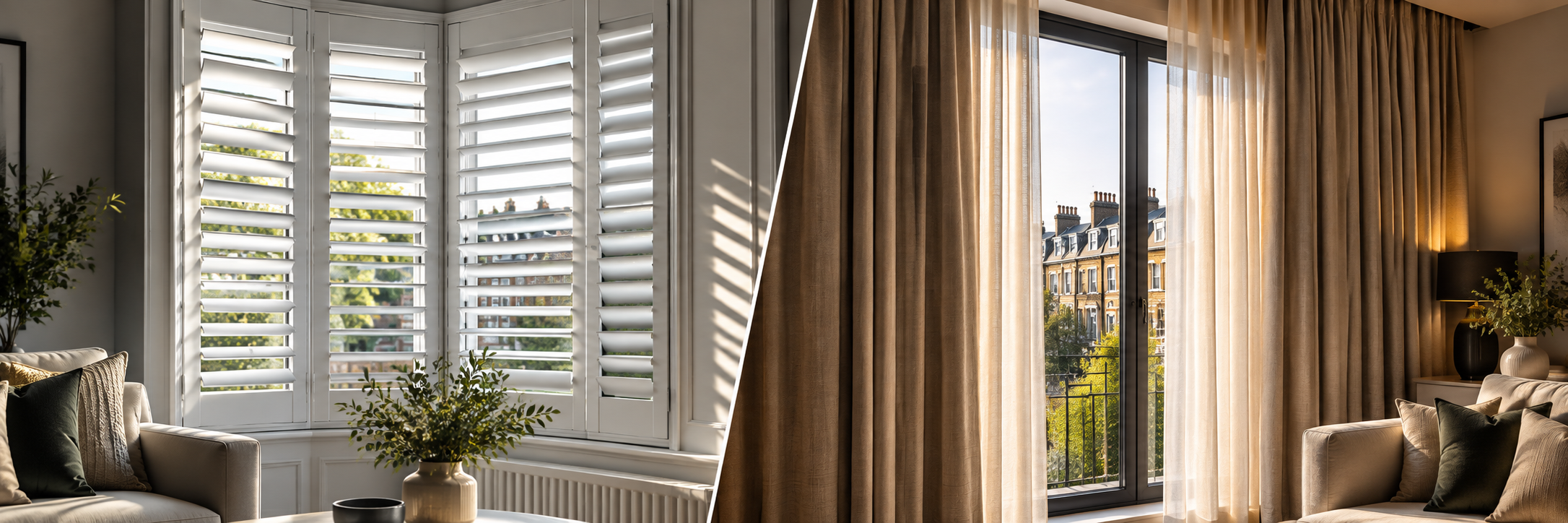
Heat escapes through a window mainly by two routes: straight through the glass, and around gaps at the edges of the frame where warm air can escape and cold air can enter. A well-fitted shutter panel sits inside the reveal and closes against the frame or surrounding wood. This can reduce draughts around the edges more effectively than a curtain hanging loosely in front of the glass with gaps at the top and sides.
Curtains reduce heat loss too. Official government draught-proofing guidance recommends curtains made from heavy material as a simple way to reduce heat loss through a window overnight. A heavy, floor-length curtain with good coverage can perform much better than a short, thin curtain with large gaps around it.
Where shutters have an advantage is consistency. A curtain only provides its full benefit while it is drawn and its performance depends heavily on its weight, length and fit. A shutter’s framed construction remains in the same position each time the panels and louvres are closed.
What we don’t have: London Blinds 4U does not claim independent laboratory figures comparing the heat loss of our specific shutters against lined curtains. The comparison here is based on the physical differences between the two window coverings rather than invented percentages.
Shutters vs Curtains for Privacy
This is where shutters have a practical advantage for many homes. Tilting the louvres lets you restrict the direct sightline into a room from the street or a neighbouring property while still allowing daylight through. A curtain cannot provide the same level of adjustment without adding another window covering behind it.
Tier on tier shutters take this further because the upper and lower sections operate independently. You can keep the lower section closed for eye-level privacy while leaving the upper section open for natural light.
For ground-floor rooms facing directly onto the street, which are common across East London areas such as Barking, Dagenham, East Ham and Ilford, this adjustable privacy can be particularly useful. For upper-floor rooms with little direct overlook, insulation, maintenance and light control may matter more.
Shutters vs Curtains: Full Comparison
| Factor | Shutters | Curtains |
|---|---|---|
| Draught and heat retention | Generally stronger due to the close framed fit around the window | Helpful when heavy and floor-length, weaker if thin or short |
| Adjustable privacy through the day | Strong, louvres can be tilted without opening the whole panel | Limited, largely open or closed |
| Portability | None, they are fitted to the property | Can be taken down, changed or moved with you |
| Rented property suitability | Usually needs landlord agreement before fitting | Usually simpler to install and remove at the end of a tenancy |
| Maintenance | Usually cleaned by wiping the panels and louvres | May need periodic washing or dry cleaning depending on the fabric |
| Changing the room’s look | A long-term fitted choice | Easy to replace with a different fabric, pattern or colour |
| Bay windows and period sash frames | Made to fit individual sections of the bay | Can work, though the curtain track and fabric need to follow the bay correctly |
| Child safety | No operating cords on the shutter itself | Depends on the complete window setup and any cords or accessories used |
When Shutters Are the Better Fit
Shutters suit homeowners who want a long-term, low-maintenance window solution and are not planning to change the room’s look frequently. They work particularly well for ground-floor rooms and street-facing windows where adjustable privacy matters throughout the day.
They can be particularly useful for bay windows and non-standard window shapes because individual shutter sections can be made to fit the shape of the window.
When Curtains Are the Better Fit
Curtains are usually the more practical choice if you’re renting and cannot make permanent alterations to the property. They suit anyone who likes changing a room’s appearance with different fabrics, colours or patterns.
For very large or unusually shaped windows, curtains may be combined with Roman blinds or roller blinds to provide more control over daylight and privacy.
Shutters vs Curtains: Real London Home Scenarios
A ground-floor Victorian terrace bay window in Leyton, facing directly onto the pavement: tier on tier shutters suit this type of window well, giving privacy at eye level while keeping the upper section available for natural light.
A rented flat in Ilford on a twelve-month tenancy: curtains are likely to be the more practical choice since fitting shutters into a property you do not own requires more commitment and landlord approval.
A first-floor bedroom in a new-build flat in Stratford with no direct overlook: privacy may be less of a concern, so insulation, maintenance and light control become more important parts of the decision.
A home office in a converted warehouse flat in Poplar with a large industrial-style window: sliding shutters can suit larger openings where a conventional hinged shutter arrangement may not be practical.
Common Mistakes When Choosing Between Shutters and Curtains
- Choosing shutters purely for insulation on a short-term let without considering that they remain fitted to the property when you leave.
- Buying thin, short curtains and expecting the same heat retention as heavy, lined, floor-length curtains.
- Assuming a simple straight curtain track will suit every bay window. Bay windows need the track and fabric to follow the shape correctly.
- Fitting shutters into a rented property without getting the landlord’s agreement first.
London Blinds 4U provides free measuring and fitting for made to measure blinds and shutters across East London and the wider London area. Our areas we cover include North London, South London, West London, Central London and surrounding areas.
Shutters vs Curtains FAQs
Q: Do interior shutters actually provide insulation?
A: Yes, though the exact improvement depends on the window, fit and shutter material. A fitted shutter creates another layer between the room and the glass and can help reduce draughts around the window area.
Q: Are curtains actually any good for keeping heat in?
A: Yes. Heavy, floor-length curtains can reduce heat loss through windows overnight. Thin, short or poorly fitted curtains provide less benefit because weight and coverage matter.
Q: Can I Have Both Shutters and Curtains on the Same Window?
A: Yes. Some homeowners combine shutters with curtains for a softer appearance or extra room darkening at night. The combination takes more space around the window, so it needs to be planned before fitting.
Q: Which Is Better for a Bay Window, Shutters or Curtains?
A: Shutters can work particularly well on bay windows because each section can be measured and made individually. Curtains can work too, but the track needs to follow the shape of the bay correctly.
Q: Do Shutters Work in a Rented Flat?
A: They can, but you should get the landlord’s agreement before installation because the shutter frame needs to be fixed to the property. Curtains are usually easier to remove at the end of a tenancy.
Q: Are Shutters Harder to Keep Clean Than Curtains?
A: Shutters normally need regular dusting and occasional wiping. Curtains may need washing or dry cleaning depending on the fabric and can hold dust and room odours over time.
Q: Do Shutters or Curtains Offer Better Child Safety?
A: Shutters operate without hanging control cords. Curtains themselves do not normally need operating cords either, but any blind fitted alongside them must meet the relevant child safety requirements. Read our guide to blind cord safety in the UK.
Q: Which Lasts Longer, Shutters or Curtains?
A: Shutters are a long-term fitted window covering and do not contain fabric that can fade or fray. Curtains can last for many years too, but their lifespan varies considerably depending on fabric quality, sunlight exposure, cleaning and everyday use.
If you’re comparing shutters and curtains for your London home, book a free home measuring visit with London Blinds 4U. We can measure your windows, look at the room and discuss which option suits your privacy, light control and practical needs.