
Best Blinds for Bedrooms: A Complete Buying Guide for East London Homes
A bedroom window has one job that no other room shares: it has to let you sleep. That single requirement changes almost every decision that goes into choosing a blind, from fabric weight through to how the blind is fitted in the recess. Get it right and you get a room that is dark, quiet and private on demand. Get it wrong and you end up with a blind that looks the part in the shop but leaves a stripe of streetlight across the ceiling every night.
In short: for most East London bedrooms, a made to measure roller or Roman blind fitted to an outside recess with a light-blocking lining gives the best balance of darkness, cost and style, while full height shutters suit bay-fronted Victorian bedrooms and dedicated Velux blinds are the only sensible option for loft conversion bedrooms with roof windows. No single blind is right for every bedroom, and this guide sets out which one suits which situation, including where blackout claims fall short of what people expect.
Key points before you buy:
- Recess-fit blackout blinds still leak light down both sides of the frame. True blackout needs side channels or an outside recess fit with generous overlap.
- Bay windows, sash windows and loft rooms each need a different approach, because they are physically different problems.
- Any blind with a looped cord in a child’s bedroom or nursery must have a child safety device fitted, and cordless options remove the risk entirely.
- Fabric openness factor (how tightly a roller fabric is woven) has a bigger effect on how dark a bedroom feels than most people realise before they order.
- A free home measuring visit catches the problems above before they become an expensive mistake, particularly in older East London properties where window recesses are rarely perfectly square.
What Makes a Bedroom Different From Every Other Room
Most rooms in a house are used with the lights on, so the blind is a background detail. A bedroom is used in the dark, often at odd hours if you work shifts, and you notice every gap of light and every draught a living room would never register. That changes the priority order. In a kitchen, wipeable fabric and heat resistance come first. In a bedroom, light control, privacy after dark, and a genuinely quiet mechanism (no cord clattering against the glass at 2am) matter most, with style close behind.
East London adds its own variables. Streetlighting along routes like the A13 and A406 is bright and constant, so a bedroom on a main road needs stronger light control than one on a quiet side street in Chadwell Heath. Victorian terraces in Leyton, Walthamstow and Forest Gate typically have bay-fronted front bedrooms with sash windows, while newer flats around Stratford, Canning Town and Docklands tend to have simpler rectangular openings. Loft conversions, common across Dagenham, Barking and Romford as families extend rather than move, bring roof windows into the mix, which rules out most conventional blind types entirely.
Do Blackout Blinds Actually Block Out All the Light?
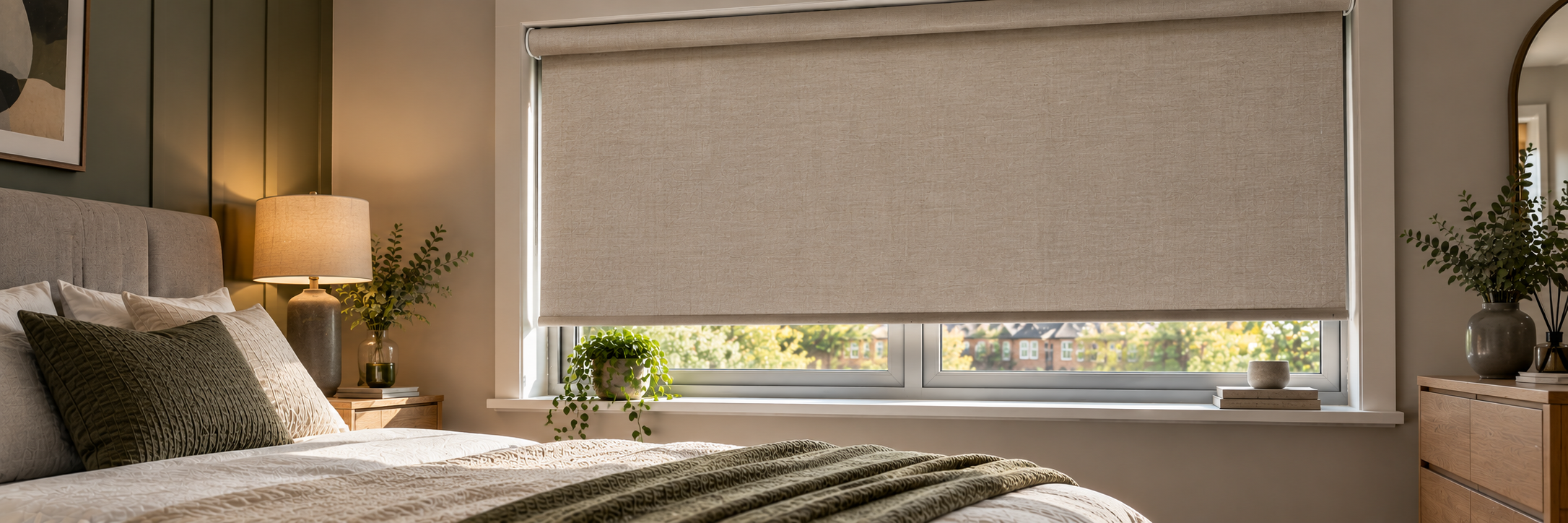
Not on their own, and this is the single most common source of disappointment when people buy a “blackout blind” expecting a completely dark room. Blackout coating or lining stops light passing through the fabric itself, but it does nothing about the 15 to 20mm gap that exists down each side of a standard recess-fit roller or vertical blind. That gap is exactly where streetlight, security lights and early summer mornings get in.
If a genuinely dark room matters, whether for shift work, a nursery, or simply struggling to sleep with any light in the room, there are two proper fixes. Side channels are narrow tracks fitted to the reveal that the blind runs inside, closing off the gap completely. An outside recess fit mounts the blind on the wall above and around the window rather than inside it, with fabric wide enough to overlap the frame on every side. Both cost more than a simple recess-fit blind and both need planning before ordering, which is exactly what a free home measuring visit is for.
If neither of those is an option, a well-fitted recess blackout roller or a lined and interlined Roman blind will still cut the vast majority of light and noticeably improve sleep quality for most people. It just will not deliver total darkness, and it is worth knowing that going in rather than finding out on the first night.
Which Blind Suits Which Type of Bedroom Window?
The window itself, not personal taste, should usually decide the shortlist. The table below sets out the combinations we see most often across East London bedrooms, what tends to work, and where that recommendation breaks down.
| Bedroom window type | Best blind option | Why it works | Where it falls down |
|---|---|---|---|
| Victorian bay window, front bedroom (Leyton, Walthamstow, Forest Gate) | Full height shutters, or a Roman blind per pane section | Shutters handle the angled sections of a bay cleanly and give strong privacy after dark without one huge sweep of fabric; per-section Roman blinds avoid the sagging look of one wide blind stretched across a bay | A single roller blind stretched across the whole bay looks wrong and rarely closes properly at the angled joints |
| Sash window, period terrace bedroom | Roman blind, or wooden Venetian blind | Both suit the proportions of a tall, narrow sash window and can be fitted inside a recess that is rarely a true rectangle in Victorian housing | Roller blinds often reveal how out-of-square an old sash recess is, since the fabric hangs from a straight roll |
| Small box room or new-build bedroom (Stratford, Barking, Romford new builds) | Roller blind or aluminium Venetian blind | Both are compact, inexpensive to run day to day and suit the simpler rectangular openings typical of newer builds | Neither gives full blackout without an outside recess fit if the room faces a streetlight |
| Loft conversion bedroom with a roof window | Dedicated Velux-style blind, ordered to the exact window code | Roof windows sit at an angle and need a blind designed to clip into that specific frame; nothing else fits or stays in place safely | Standard vertical blinds cannot be fitted to a roof window at all |
| Child’s bedroom or nursery | Cordless roller blind, or shutters | Removes any looped cord from the room entirely, which is the safest option regardless of what safety devices are fitted to a corded alternative | Cordless mechanisms typically cost more than an equivalent corded blind |
| Rented flat bedroom, no drilling allowed | Perfect fit or pressure-fit blind options, discussed with your fitter | Can be fitted without drilling into the window frame or wall, which matters when a tenancy agreement forbids it | Fitting options are more limited and it is worth checking with your landlord and your fitter before ordering |
Roller, Roman or Wooden Venetian: Which Fabric Suits a Bedroom?
Once the window type has narrowed the shortlist, the fabric or slat choice within that shortlist depends on how much darkness and privacy you want against how much natural light you are willing to give up during the day.
Roller blind fabric is rated by its openness factor, usually shown as 1%, 3%, 5% or 10%. A 1% openness fabric is close to opaque even without a blackout backing, cutting glare hard but also making the room noticeably darker during the day. A 5% fabric lets you see out and lets soft, diffused light through, but at a low winter sun angle it will still glare rather than block it. Most people find 1% or 3% suits a bedroom best, saving the higher percentages for living rooms where daytime privacy without full blackness matters more than night-time darkness.
Roman blinds work differently. A lined Roman blind blocks a similar amount of light to a mid-openness roller when closed, and an interlined version, with a thick interlining sewn between the face fabric and the blackout lining, adds a soft, quilted layer that also deadens sound a little more than a single fabric layer. They suit period bedrooms particularly well, since the folded stack sits neatly at the top of a sash window rather than a rolled tube of fabric.
Wooden Venetian blinds give you control that fabric cannot: tilt the slats to let air and a sliver of light through while still blocking a direct line of sight from outside, useful on a street where privacy matters even with a window cracked open. They suit bedrooms well, since bedrooms rarely suffer the humidity that warps wood in a bathroom. The trade-off is that even fully closed, the slats let some light through at the edges where they overlap, so they will not match the total darkness of a well-fitted blackout roller or interlined Roman blind.
Are Shutters a Good Choice for a Bedroom?
Shutters suit bedrooms that need strong privacy and a permanent, furniture-grade finish rather than a soft fabric look. Full height shutters cover the whole window in one panel and work well in larger bedrooms, including bay-fronted period rooms. Cafe style shutters cover only the lower half, which suits a ground or first floor bedroom overlooking a street or a neighbour’s garden, giving privacy at eye level while still letting daylight in through the uncovered top half. Tier on tier shutters split the window into two independent sections, so the top can stay open for light while the bottom stays closed for privacy.
Shutters do not give total blackout, since louvres still allow some light around their edges, but they are excellent for privacy and for a room that needs to look finished rather than dressed. They are also the quietest option in the range, with no fabric to rustle and no cord to knock against the frame in a draught.
Blind Cord Safety in Children’s Bedrooms and Nurseries
Any looped blind cord is a strangulation hazard for a young child. The official UK government guidance on blind cord child safety sets out three practical steps: fitting a tidy or tensioner so the cord stays permanently pulled tight against a wall or frame, fitting a cleat positioned at least 1.5 metres off the floor so it is out of a child’s reach, and wrapping the cord in a figure of eight around that cleat every time the blind is used. The same guidance recommends keeping cots, beds and highchairs away from windows altogether, since children climb.
The simplest solution for a nursery is to avoid a looped cord entirely with a cordless roller blind or a shutter, both operated by hand rather than by pulling a cord. If a corded blind is already fitted, retrofitting a cleat or tensioner is a small job that removes the risk without replacing the blind. We can talk you through safe options as part of a free home measuring visit, and our separate guide on blind cord safety rules in the UK covers the fitting detail in full.
How to Measure a Bedroom Window So Light Doesn’t Leak
The single most common reason a bedroom blind disappoints is a measurement that was technically correct but wrong for the goal. A recess measurement, taken to fit neatly inside the window reveal, will always leave a gap down both sides once you account for the blind’s own bracket and fabric roll. If darkness is the priority, an outside recess measurement, overlapping the frame on the wall around it, is the one to use instead, and it is worth saying so clearly when you book a measuring visit rather than assuming the fitter will guess your priority.
In older East London housing, particularly Victorian terraces in Leyton, Walthamstow and East Ham, window recesses are rarely a true rectangle. A recess can be narrower at the top than the bottom, or the depth can vary from one side to the other where the frame has moved slightly over more than a century. That is why a proper measuring visit takes the width and depth in three places, top, middle and bottom, and uses the smallest measurement found, so the blind is guaranteed to fit rather than jam against the narrowest point. Our guide on measuring for blinds, covering recess, exact and outside recess fitting explains each method, and our free measuring service does this properly on site rather than leaving it to guesswork.
Looking After Bedroom Blinds Once They’re Fitted
Bedrooms have low humidity and low grease compared with kitchens and bathrooms, which is exactly why wood and fabric options that struggle elsewhere perform well here. A wooden Venetian blind in a bedroom should stay dry and stable for years, needing only an occasional dust with a soft brush or a damp microfibre cloth along each slat. Fabric roller and Roman blinds collect household dust like any soft furnishing, so a light vacuum with a brush attachment every few weeks keeps them looking fresh. Shutters, having no fabric at all, are the lowest maintenance option in a bedroom, needing only an occasional wipe with a dry or slightly damp cloth.
Common Mistakes People Make Choosing Bedroom Blinds
A handful of avoidable mistakes come up again and again. Ordering a recess-fit blackout blind and expecting total darkness, then being disappointed by the light down the sides, when an outside recess fit was the right call from the start. Stretching a single roller blind across a full bay window, which looks wrong on the angled sections and rarely closes cleanly. Fitting a corded blind in a nursery without a cleat or tensioner, a genuine safety risk rather than a style choice. Choosing a fabric from a small sample swatch rather than considering how its openness factor behaves at the size of a full bedroom window, where a fabric that looked appropriately soft in the shop can turn out far more translucent, or far darker, once it is up. And skipping a proper three-point measurement in an older property, leaving the blind a few millimetres out at one end of the recess.
A free home measuring visit exists precisely to catch these before an order goes in, rather than after a blind arrives and does not do what was expected.
Bedroom Blinds FAQ
Q: What is the best type of blind for a genuinely dark bedroom?
A: A recess-fit blind on its own will not give total darkness, however dark the fabric. For a genuinely dark room, choose an outside recess fit or side channels with a blackout roller blind, or a fully interlined Roman blind. Both need to be specified before ordering, so mention it at your measuring visit.
Q: Do blackout blinds block out all light?
A: No. Blackout coating stops light passing through the fabric itself, but light still gets in down the sides of a standard recess-fit blind, typically 15 to 20mm on each edge. For total darkness you need an outside recess fit or side channels.
Q: Are Roman blinds or curtains better for a bedroom?
A: Both can work well. A lined or interlined Roman blind gives strong light control and a neater look at the top of the window than curtains, and suits period sash windows particularly well. It depends on the window and the look you want as much as the performance.
Q: Can I fit blinds to Velux or roof windows in a loft bedroom?
A: Yes, but only with a blind made specifically for that window model, since roof windows sit at an angle and use a different fitting system entirely. A standard vertical or roller blind cannot be adapted to fit one safely.
Q: What is the safest type of blind for a baby’s nursery?
A: A cordless blind, such as a cordless roller blind, or shutters operated directly by hand. Both remove any looped cord from the room entirely. If a corded blind is already fitted, adding a cleat or tensioner at least 1.5 metres off the floor reduces the risk significantly.
Q: Do wooden blinds work in a bedroom, or will they warp like they can in a bathroom?
A: Wooden Venetian blinds generally do very well in bedrooms. The warping problem with wood is caused by humidity, which bathrooms have in abundance and bedrooms typically do not.
Q: How do I stop light coming in around the edges of my bedroom blind?
A: Move to an outside recess fit, overlapping the frame on the wall rather than sitting inside the recess, or add side channels that close the gap at the reveal. A standard recess fit cannot fully solve this on its own.
Q: Do I need a professional to measure and fit bedroom blinds, or can I do it myself?
A: You can do it yourself, but the most common complaints, light leaking at the sides and a bay window that does not close neatly, both come from measurement or fitting choices rather than the product. A free home measuring and fitting visit removes that risk and lets you talk through blackout, safety and window type before you commit to an order.
Ready to Choose the Right Bedroom Blinds?
Every bedroom window in East London is a slightly different problem, from a bay-fronted Victorian terrace to a loft conversion with a roof window. Book a free, no-obligation home measuring visit and we will look at your actual window, talk through what genuine blackout, privacy or child safety needs, and recommend the option that will actually do what you want once it’s up. Call us on 07852 257 307 or email info@londonblinds4u.co.uk, or visit our Roman blinds, roller blinds and shutters pages to explore the full range.