
Blinds East London
Blinds East London: Made to Measure, Fitted Free
London Blinds 4U fits made to measure roller, Venetian, vertical, Roman and Velux blinds across East London, from Dagenham to Canary Wharf. Measuring and fitting are both free. The right blind depends on your window type, room and property: a Victorian sash bay needs a different answer to a new-build flat in Stratford.
Key takeaways
- Free measuring and free fitting on every order, with no call-out charge.
- A recess-fit blackout roller still leaks 15 to 20mm of light down each side; true blackout needs side channels or an outside-recess fit.
- BS EN 13120 has required breakaway cord devices on UK blinds since 28 February 2014; a 6kg pull must release the loop within 5 seconds.
- Fabric openness factor (1% to 10%) trades glare control against how much of the outside world you can actually see.
- Honeycomb cell blinds cut heat transfer through a window by roughly 50% to 62% depending on cell size, which matters far more than blind choice in a conservatory.
What blinds does London Blinds 4U fit across East London?
London Blinds 4U is a made to measure blinds and shutters business based on Oxlow Lane in Dagenham, fitting across East London and the Essex border: Barking, Ilford, Romford, Stratford, Walthamstow, East Ham, Leyton, Forest Gate, Canning Town, Poplar, Docklands, Canary Wharf, Hackney, Chadwell Heath, Barkingside and the surrounding area.
We supply and fit roller blinds, Venetian blinds (aluminium and real wood), vertical blinds, Roman blinds and Velux blinds for roof windows. Every order includes a free home measuring visit and free fitting by our own team, not a subcontractor working from a national call centre’s job list.
Most East London homes and flats we measure fall into one of three broad categories, and the right blind genuinely differs between them: Victorian and Edwardian terraces with sash or bay windows, common across Leyton, Walthamstow, Forest Gate and parts of Ilford; 1930s semis and post-war ex-council stock with uPVC casement windows, common in Dagenham, Barking, Chadwell Heath and Romford; and new-build flats and apartments with large aluminium-framed windows or floor to ceiling glazing, common in Stratford, Canary Wharf and Docklands. A blind that suits one of these three well is often the wrong choice for another, which is what the matrix below sets out.

Which blind is right for your window? The window, room and fabric matrix
This is the single most useful section on this page, and it is the thing every other blinds site in London currently leaves out. Most competitor sites organise their content by product (a roller blind page, a Venetian blind page) and leave the customer to work out which one actually suits their window. The better starting point is the window and the room, since that is what actually determines the right answer.
By window type
| Window type | Recommended blind | Why | Wrong for |
| Victorian box-sash | Roman blind or wood Venetian | Sits inside the recess without fouling the sash mechanism; wood Venetian echoes period detailing | Vertical blinds, which look institutional against period proportions |
| Bay window (period) | Roller or Venetian, fitted per section | Bay windows are rarely one continuous plane; a single blind across the whole bay leaves gaps or fouls at the angled joins | A single wide roller blind spanning the whole bay |
| uPVC casement (post-war/ex-council) | Roller blind or aluminium Venetian | Clean recess fit, no warping risk, easy to keep clean | Real wood Venetian, which can be affected by condensation on older glazing units |
| Large aluminium-framed window (new-build flat) | Roller blind, wide-width or motorised | Contemporary windows often exceed standard blind widths; motorised control suits floor to ceiling glazing you cannot reach easily | Roman blinds on very wide openings, where fabric weight makes the mechanism unreliable |
| Velux / roof window | Purpose-made Velux blind | Needs to clip into the frame at an angle and resist condensation running down the glass | Standard vertical or roller blinds, which cannot be safely fitted to a roof window |
| Bifold or patio door | Vertical blinds | Verticals stack cleanly to one side and slats do not catch on door handles the way a roller chain can | Roman blinds, which cannot retract fully clear of a sliding or folding door |
| Conservatory roof and walls | Thermal/pleated or honeycomb blind | The real problem is heat gain through the glass, not light; a plain roller does very little for that | A standard roller blind on the roof panels |
By room
| Room | Requirement | Recommended blind | Wrong for |
| Bedroom | Blackout, or as close as possible | Blackout roller with side channels, or blackout Roman blind | A recess-fit blackout roller alone, if total darkness is expected |
| Bathroom | Moisture resistance | PVC/faux-wood Venetian or a moisture-rated roller fabric | Real wood Venetian blinds, which absorb humidity and warp over time |
| Kitchen | Easy to wipe clean | Aluminium Venetian or a wipeable roller fabric | Fabric Roman blinds, which trap grease in the pleats |
| Living room | Light control with a view retained | Roller blind at 3% to 5% openness, or Venetian | A 1% blackout-style fabric, which kills the view unnecessarily |
| Home office | Screen glare control | Venetian or vertical, adjustable slat angle | A plain roller blind, which forces an all-or-nothing choice |
| Nursery | Child safety, non-negotiable | Cordless blind or a fully compliant breakaway system | Any corded blind without a properly fitted breakaway device |
| Conservatory | Heat control, not light control | Thermal pleated or honeycomb cell blind | A standard single-layer roller |
| Rented flat | No drilling allowed | Perfect-fit or no-drill bracket system | Any blind requiring drilling into the frame or wall |
Do blackout blinds actually block out all the light?
No, not on their own, and this is worth saying plainly because nobody else in this market does. A blackout fabric blind blocks light passing through the fabric itself, but it does not seal the sides of the window. On a standard recess-fit roller blind, light leaks down both edges, typically 15 to 20mm on each side, because the fabric has to be narrower than the recess to allow the blind to operate without fouling the sides.
That gap is enough to let a visible strip of daylight or streetlight into the room, which is the single most common disappointment with blackout blinds across the whole industry, not just here. If a genuinely dark room matters, for shift work, a nursery, or simply an undisturbed lie-in through a June sunrise, you need one of two things: a blind fitted with side channels that seal the edges, or an outside-recess fit where the blind is mounted on the wall outside the recess with enough overlap on all four sides to close the gaps entirely.
We would rather explain this before a customer orders than have them discover it after fitting. If true blackout matters to you, say so at your measuring visit and we will fit accordingly rather than supply a standard recess-fit blind that will not do the job.
How does fabric openness factor change what you actually see?
Roller blind screening fabrics (rather than solid blackout or dim-out fabrics) are rated by openness factor, the percentage of the weave that is open rather than woven thread. This number determines what you can see through the fabric and how much glare it cuts, and it is rarely explained anywhere a customer can find it before buying.
- 1% openness: the view outside is reduced to shapes, a tree or a parked car reads as an outline rather than detail. Glare is almost eliminated. At night with interior lights on, almost nothing is visible from outside, the closest a screen fabric gets to real privacy after dark.
- 3% openness: the most commonly chosen middle option. You can clearly see outdoor activity, people walking, cars passing, during the day, while still cutting meaningful glare. Night-time privacy is reduced compared with 1%, since interior light shows more clearly through the fabric.
- 5% openness: view quality improves noticeably, colours and movement read clearly. The trade-off is real: daytime privacy drops further, and at night with lights on, someone outside can see into the room more clearly.
- 10% openness: close to no shading in visual terms, useful mainly where the view matters more than glare control or privacy, for example a home office window facing a garden rather than a street.
For most East London homes facing a street or neighbouring windows, 3% is the sensible default. For a north-facing room where daylight is already limited, avoid 1% fabric, since it will make the room noticeably darker than it needs to be.
Are blinds child safe? BS EN 13120 and cord safety explained
Blind cords and chains are a genuine strangulation hazard for young children, and this is a documented safety issue, not a marketing point. Since 28 February 2014, British Standard BS EN 13120 has required all internal blinds sold in the UK to eliminate hazardous cord loops for children aged 0 to 42 months, either through a breakaway device that releases the loop when roughly 6kg of force is applied within 5 seconds, or through a fixed tensioning device where the two strands of any loop are no more than 50mm apart at the point they exit the device, mounted no lower than 1.5 metres from the floor.
Every blind we fit meets this standard as a baseline, with the correct cleats, breakaway connectors and warning labels supplied and fitted. For a nursery specifically, or any room where a child sleeps or plays unsupervised, we would recommend going further than the legal minimum and choosing a cordless blind, motorised or spring-operated with no external cord at all, removing the hazard rather than managing it. If you already have older blinds without a breakaway device fitted, this is worth checking regardless of whether you are ordering anything new.
Blinds for East London’s Victorian terraces, new builds and ex-council flats
East London is not one type of housing, and treating it as one is exactly what every other blinds website in London does. The right blind for a Victorian box-sash window in a Leyton or Walthamstow terrace is a different answer from the right blind for a new-build one-bedroom flat in Stratford, and different again from a 1960s ex-council maisonette in Barking or Chadwell Heath.
Victorian and Edwardian terraces, common across Leyton, Walthamstow, Forest Gate, parts of Ilford and the older streets of East Ham, typically have box-sash windows, often with bay fronts. These recesses are frequently not square, a genuine measuring challenge covered later on this page, and period proportions generally suit a Roman blind or a wood Venetian better than a stark aluminium Venetian or a wide roller.
1930s semis and ex-council stock, widespread across Dagenham, Barking, Chadwell Heath, Becontree and much of Romford, tend to have uPVC casement windows fitted at some point after the original build. These take roller blinds and aluminium Venetians well, with no risk of the warping that real wood can suffer if condensation has ever been an issue on the glazing unit.
New-build flats and apartments around Stratford, the Docklands and Canary Wharf typically have larger aluminium-framed windows, sometimes floor to ceiling, and often face directly onto other buildings or a busy street. Wide-width roller blinds or motorised options suit these better than standard-width products, and privacy at openness factor 1% to 3% is usually the right call given the density of overlooking properties in these developments.
Roller blinds vs Venetian blinds vs Roman blinds: which wins for what
No single blind wins every comparison, and being honest about where each one loses is more useful than a generic “it depends.”
Roller blinds win on cost, ease of cleaning and suitability for kitchens and bathrooms in a wipeable fabric, and lose on light control flexibility, since a roller blind is broadly on or off rather than adjustable by degree the way slats are.
Venetian blinds win on adjustable light control, letting you angle slats to bounce light onto a ceiling rather than blocking it entirely, which suits home offices and living rooms well, and lose in bathrooms if chosen in real wood, and lose on ease of cleaning compared with a roller blind, since dust settles on every slat individually.
Roman blinds win on look, particularly in period properties, and on softening a room compared with the more clinical look of a roller or aluminium Venetian, and lose in kitchens, where grease collects in the folds, and in high-humidity bathrooms, and are usually the most expensive of the three per window.
Which blinds actually work in a conservatory or south-facing room?
The instinct is to treat a hot conservatory as a light problem and reach for a blackout or dark roller blind. That is usually the wrong diagnosis. The problem in most conservatories, especially south-facing ones, common across East London’s newer extensions, is heat gain through the glass, not glare.
A standard single-layer roller blind does very little to stop that heat gain, because it shades the glass rather than insulating it. Thermal, pleated or honeycomb blinds work differently: the cell structure traps a layer of air that acts as insulation. Independent testing on honeycomb blinds has recorded average reductions in heat transmittance through the glass of around 56%, ranging from roughly 50% with a single-cell 25mm structure up to around 62% with a double-cell 62mm structure, and building-level modelling with these blinds kept closed has shown solar heat gain reductions of close to 58% and heat loss reductions of over 64%.
In practical terms, a south-facing conservatory that reaches 40°C on a summer afternoon will not be meaningfully cooled by a plain roller blind. A honeycomb or pleated thermal blind makes a real, measurable difference. It costs more upfront, and it is the honest answer even where the cheaper roller blind would be the easier sale.
How much do made to measure blinds cost in East London?
Data needed to state a specific price range with confidence: current per-window pricing by product type and fabric grade is not included in the material supplied for this page. What can be said honestly: measuring and the initial home visit are free with no obligation to buy, and the final price depends on the blind type, fabric or material grade, window size, and whether the blind is manual or motorised. Get a free, no-obligation quote at your measuring visit rather than relying on a generic online price, since window sizes and fabric choice both move the final cost significantly.
Who blinds from London Blinds 4U are NOT right for
Being upfront about where a product does not fit is worth more than pretending everything suits everyone.
- If you want a genuinely pitch-dark bedroom and are only willing to pay for a standard recess-fit blackout roller, we would rather tell you now: it will not get you there, light will still show at both edges. You need side channels or an outside-recess fit, which costs more, and we would say so before you order rather than after.
- If you have a real wood Venetian blind in mind for a bathroom with a shower running daily, we would steer you toward PVC or faux-wood instead. Real wood will absorb the humidity over time and the slats will cup or warp, and no amount of careful fitting changes that basic material behaviour.
- If your conservatory genuinely overheats in summer and your budget only stretches to a standard roller blind, we would tell you plainly that it will not solve the heat problem, only the light problem, and that a thermal or honeycomb blind is the product that actually addresses what you are trying to fix.
7 measuring and fitting mistakes that ruin a blinds order
- Measuring only once. Windows, especially in older East London housing, are frequently not perfectly square. We measure in three places, top, middle and bottom of the recess, and use the smallest measurement for a recess fit, because a blind cut to the largest reading simply will not fit into a narrower point lower down.
- Confusing recess-fit with exact-size. A recess-fit blind is measured to sit inside the window reveal; an exact-size or outside-recess blind is measured to overlap the opening from outside. Ordering the wrong one for how it will actually be fitted is one of the most common and costly mistakes in the trade.
- Fitting real wood Venetian blinds in a bathroom. Covered above, and worth repeating: humidity warps timber over time regardless of how well it was fitted on day one.
- Fitting fabric Roman blinds in a working kitchen. Grease and steam settle into fabric folds and are genuinely difficult to clean out afterwards.
- Spanning a whole bay window with a single roller blind. Bay windows are rarely one flat plane; a single blind across the whole bay will not sit correctly against the angled joins and usually leaves light gaps at the corners.
- Expecting a recess-fit blackout roller to fully black out a room. As covered above, this is the single most common unmet expectation in the whole blinds industry, and it is entirely avoidable by choosing the right fitting method from the outset.
- Fitting a corded blind in a nursery or child’s bedroom without a properly installed and tested breakaway device, or choosing a corded option at all where a cordless one is practical.
How long does blinds fitting take from quote to fitted?
Data needed to state a specific average lead time: an internal average across all East London jobs is not included in the material supplied for this page. What supplied customer reviews do show: several customers describe fitting completed within one to two weeks of ordering, with one review noting fitting completed within a week, faster than the 7 to 9 day window originally quoted. Actual lead time depends on the specific fabric and product ordered and is confirmed at your measuring visit.
What East London customers say
We only use genuine, first-party Google reviews with the reviewer’s own name and wording, never invented feedback.
- “I had venetian blinds, vertical and roller blinds fitted. They came to measure my windows and gave me a quote in a day. Within weeks, they had my order and installed straightaway.” (Sia Lily, Google review)
- “I had some white vertical blinds fitted today and I am extremely happy with them. The service was quick, professional and well worth the money.” (Joanna Scott, Google review)
- “Excellent service. I have had vertical, weighted, bead less blackout blinds fitted on 4 windows in a new build property in Dagenham. The blinds offer blackout whilst looking fabulous.” (Lauren Baker, Google review)
Note: the review above describes a positive blackout outcome using a weighted, bead-less system on a new build property; it does not specify whether side channels or an outside-recess fit were used. Confirm the specific configuration with the business before citing this as proof of the side-channel approach described earlier on this page, rather than assuming it.
Blinds East London FAQ
Q1: Are blinds or shutters better for a bay window?
Both can work; shutters give a fitted, permanent look and shrug off humidity, while blinds fitted per section, not spanning the whole bay, cost less and are easier to change later.
Q2: Can I get blackout blinds that actually make a room fully dark?
Yes, but not with a standard recess-fit roller alone. You need side channels or an outside-recess fit with generous overlap; ask for this specifically when you book your measuring visit.
Q3: Do you fit blinds in rented flats without drilling?
Yes, perfect-fit and no-drill bracket systems clip into the window frame itself rather than the wall, so a tenant can remove them without leaving holes.
Q4: What blind is best for a kitchen?
An aluminium Venetian or a wipeable roller fabric, since both clean easily and do not absorb grease or steam the way fabric Roman blinds do.
Q5: Is it safe to have corded blinds with young children in the house?
All blinds we fit meet BS EN 13120, which requires a breakaway device or tensioning device to remove hazardous cord loops. For a nursery specifically, we would recommend a cordless option regardless.
Q6: What openness factor should I choose for a living room facing the street?
3% is the sensible default for most East London homes facing a street or neighbouring windows, balancing daytime view against glare and reasonable night-time privacy.
Q7: Will a blackout roller blind cool down my conservatory in summer?
No. Heat gain through conservatory glass is a heat problem, not a light problem; a thermal, pleated or honeycomb blind actually reduces it, by roughly 50% to 62% depending on the cell structure.
Q8: How do I measure my own window before you visit, just to get a rough idea?
Measure the recess width at the top, middle and bottom and use the smallest figure; but book the free measuring visit before ordering, since the home visit measurement is what the blind is actually cut to.
Q9: Do you fit blinds for offices and commercial premises as well as homes?
Yes, we fit for homes, landlords, offices and other commercial premises across East London.
Book your free measuring visit today. Call 07852 257 307 to arrange a time that works for you.

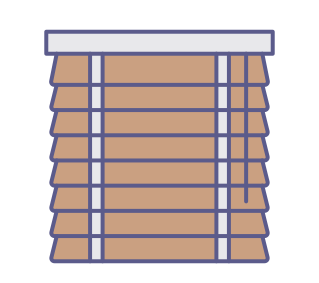
Wooden Venetian blinds - East London
We offer a range of top quality basswood Venetian Blinds in East London at unbeatable prices, all made using Excel Wood. This collection offers six stylish colours, comprising of three warm wood tones, white, black, and ivory. Excel Wood is truly a revolution in affordable wood Venetian blinds.
All our wooden Venetian blinds are available in 35 and 50mm slat sizes. A range of six coordinating tapes are available to finish the blind; 25mm tape is suitable for 35mm slat and 38mm for 50mm.



Roller blinds - East London
Our great quality Roller Blinds in East London are available in a wide range of fabrics and colours, including patterned, printed, plain, suede, water resistant and blackout. Their stylish versatility makes them a great fit for many spaces!
Roller Blinds can be installed without the need for screwing and drilling into the window frame or surrounding area, using the perfect fit.


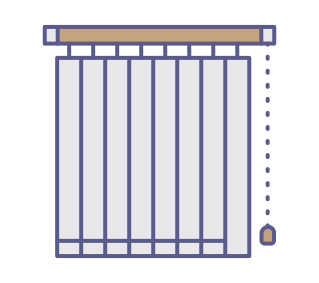
Vertical blinds - East London
Vertical Blinds in Abbey East London are the most popular types of blind we offer as they suit a variety of businesses and homes. They can be made of wood, fabric or plastic, and can be adjusted by rotation to an open or closed position by allowing the slats to overlap.
Our vertical blinds are made to measure and come in over 250 colours and fabrics in either 89mm or 127mm wide slats.


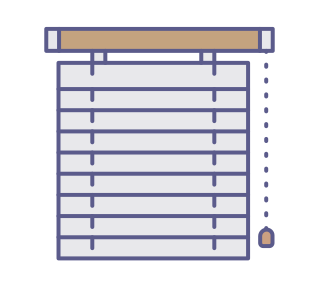
Aluminium venetian blinds - East London
The Aluminium Venetian Blinds collection in East London from LondonBlinds4U offers a spectrum of 74 colours, including a selection of silvers, vibrant colour tones and contemporary stripes. Our Aluminium Venetian Blinds are handcrafted products suitable for a range of applications.
Manufactured from the highest quality aluminium, the 25mm aluminium blinds are versatile in application, including domestic, commercial and contract markets.
The 25mm Aluminium Collection is available in six distinct finishes – Plain, Hammered, Metallic, Brushed, Perforated and Woodline.


Roman blinds - East London
LondonBlinds4U offer made to measure Roman Blinds in East London that are ideal for offices, hotels, restaurants and homes. We can offer you wide range of fabrics designed to your request.
Roman Blinds are effortlessly stylish and can be a great alternative to curtains. They are available in various different fabrics, from modern to traditional prints, and can be fully lined, which makes them perfect for bedrooms.


Perfect fit blinds - East London
LondonBlinds4U’s Perfect Fit Blinds System for Venetian blinds offers revolutionary ‘no-drill’ window blinds that snap-fit into place to become a seamless part of a UPVC window, door or conservatory.
Our system is available to order as a made to measure design using a 25mm slat size from any of the below Decora product ranges:
- 25mm Aluminium Venetian Blind Collection
- 25mm Timberlux Colours (Classic and Colour Collection only)
- 25mm Sunvent Aluminium Blinds

Velux blinds - East London
Specifically created for roof windows, Excel Roof Velux Blinds in East London have been designed to fit Velux, Fakro, Keylite and Rooflite windows. The Excel Roof Blind collection offers practical simplicity and elegant styles for roof windows in a deluxe choice of fabrics, including blackout, dimout and chic designs in a variety of sizes.
With its slimline silver fascia and side guides, Excel Roof is a slick, contemporary system which facilitates ease of operation in any type of roof window. The addition of quick reference fitting guides for each of the major roof blind manufacturers also ensures effortless installation.