
Best Blinds for Bay Windows and Bifold Doors
A bay window needs one blind per section, not a single blind stretched across the whole opening, because bay angles rarely allow one blind to sit flush and operate smoothly across all three faces. Vertical blinds or a set of Roman blinds or roller blinds per section both work well. The right choice depends on the room. Bifold and sliding doors need vertical blinds, a wide day and night blind, or a track mounted sliding panel system that can retract fully clear of the opening, since a standard roller blind is rarely wide enough and can obstruct the door when opened.
- Key numbers: most bay windows have 3 sections at angles between roughly 90 and 135 degrees to each other.
- 250+ colours is a typical range available in vertical blind fabrics.
- A single blind spanning a bay wider than around 2.5 to 3m usually starts to sag or bind at the fold points.
- Vertical blind louvres commonly come in 89mm and 127mm widths.
Why a Single Blind Rarely Works Across a Bay Window
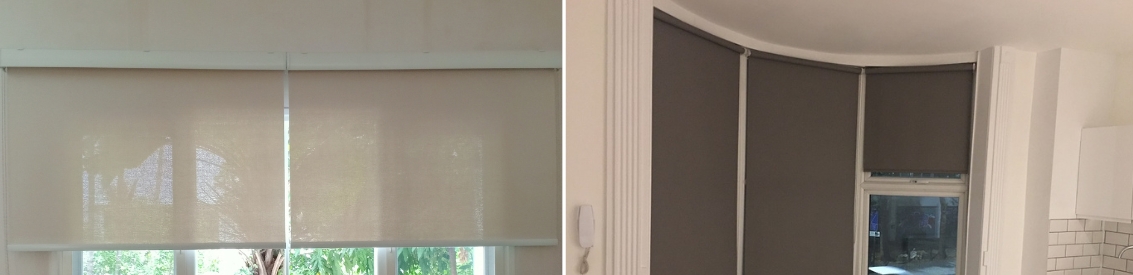
A bay window is not one flat opening. It is typically three separate window faces meeting at angles, most commonly somewhere between 90 and 135 degrees depending on the property’s era and design. A single roller or Roman blind stretched across the full width has to bridge those angles, which either means the blind does not sit flush against the glass at the angled joins, letting light and draughts through the gap, or the fabric has to be cut and folded at the join in a way that looks awkward and can bind or catch when operated. Fitting one blind per section, sized individually to that specific pane, solves both problems at once. Each blind sits flush against its own glass and operates independently. Our separate guide to the best blinds for bay windows explains this made to measure approach in more detail.
Bay Windows: What Actually Works
| Option | How it handles the angles | Best for | Trade-off |
|---|---|---|---|
| One blind per section, roller or Roman | Each blind fits its own flat pane exactly, with no bridging needed | Most bay windows, particularly Victorian and Edwardian terraces | Slightly more expensive than a single wide blind because multiple headrails and mechanisms are needed |
| Vertical blinds across the full bay | Individual louvres can follow the bay’s angle more naturally than a rigid roller fabric | Wider, shallower bay angles and larger bay windows | A more contemporary look that may suit a period property less than sectioned Romans |
| Plantation shutters shaped to the bay | Custom built frame follows the bay’s exact angles as a single integrated unit | Higher budget projects wanting a cohesive built in look | Highest cost of the bay window options and a bigger investment overall |
| Single wide blind with no sectioning | Does not handle angles well, so fabric either gaps at the joins or binds | Not recommended for genuine bay windows | The option most likely to need remaking or replacing early |
Bifold and Sliding Doors: A Different Problem Entirely
Bifold and sliding patio doors present the opposite challenge to a bay window. Instead of multiple angled sections, you have one very wide opening that needs to retract completely clear when the doors are opened, without the blind fabric or mechanism obstructing the door track. A standard roller blind is often not available wide enough for a large bifold span, and even where it is, a single wide roller can sag or bind at that width. Vertical blinds for wide windows and patio doors handle wide spans naturally, since the louvres stack neatly to one side when opened and each louvre is independently light. Wide day and night blinds and track mounted sliding panel systems are other realistic options, each suited to different preferences.
Suitability Matrix: Bay Windows and Bifold Doors by Situation
| Window type | Recommended blind | Why | Who this is wrong for |
|---|---|---|---|
| Victorian or Edwardian terrace bay, 3 sections | Roman or roller blinds, one per section | Fits each angled pane individually, avoiding gaps or binding at the joins | Very wide, shallow bays where sectioning looks visually fragmented |
| Wide, shallow angle bay | Vertical blinds across the full span | Individual louvres follow gentle angles more naturally than sectioned fabric blinds | Steep, tight bay angles where louvres cannot stack cleanly |
| Bifold doors, 3 or more panels | Vertical blinds or a wide track mounted panel system | Retracts fully clear of the door opening without obstructing use | Narrow single door openings where a standard roller works fine |
| Sliding patio door, single track | Vertical blinds or a wide day and night blind | Stacks or slides cleanly to one side, keeping the door usable | Doors under roughly 1.5m wide, where a standard roller is often simpler and cheaper |
| Small single bay window with no angle complexity | Standard roller or Roman blind | A genuinely simple window does not need the complexity of sectioning or verticals | Not applicable for a genuinely flat, single pane window |
When a Standard Blind Is the Better Choice
If your window is a single, flat opening with no bay angle at all, most of this article does not apply to you. A standard roller blind or Roman blind, sized correctly to that one pane, is the simpler and cheaper choice. Sectioning and vertical blind solutions solve bay and bifold problems. Applying them to a straightforward single window adds cost and complexity without a matching benefit.
Real Scenario: A Victorian Bay in a Walthamstow Terrace
A three section bay window in a Walthamstow terrace, with the two side panes angled at roughly 120 degrees to the central pane, had previously been fitted with a single wide roller blind that gapped noticeably at both angled joins, leaking draught and light. Refitting with three individually measured Roman blinds, one per section, each fitting flush against its own glass, resolved both the light gap and the draught, and gave a neater look overall despite the slightly higher cost of three headrails versus one.
Real Scenario: Bifold Doors Opening Onto a Garden in a Chadwell Heath Extension
A four panel bifold door installed as part of a rear extension in Chadwell Heath needed a window covering that would not obstruct the doors when folded open for garden access in summer. A standard roller blind wide enough for the full span was not practically available without custom cassette engineering, and even then risked sagging at that width. Vertical blinds, stacking cleanly to one side when opened, solved the retraction problem directly while giving full light and privacy control when the doors were closed.
Mistakes People Make With Bay Windows and Wide Doors
- Ordering a single wide blind for a bay window to save money upfront: the gaps and binding at the angled joins typically mean the blind needs replacing sooner than a correctly sectioned installation, making it a false economy.
- Assuming vertical blinds always look too commercial for a period home: modern vertical blind fabrics range widely in texture and colour, and are a valid choice for wider bays even in a period property.
- Not accounting for door swing when specifying blinds on bifold doors: a blind or headrail that projects into the door opening path causes daily friction. This needs checking at the measuring stage.
- Measuring a bay window’s total width and treating it as one flat span: each section needs its own individual measurement. See our guide to measuring for blinds for the basic fitting terms and measurement principles.
Vertical vs Roller Per Section vs Day and Night for Bays and Wide Doors
| Option | Handles bay angles | Handles wide bifold or sliding spans | Typical look |
|---|---|---|---|
| Roller or Roman, one per section | Yes, individually per pane | Not ideal for very wide continuous spans | Traditional, suits period bay windows well |
| Vertical blinds | Yes, louvres follow gentle angles naturally | Yes, stacks cleanly to one side | Contemporary and versatile across window shapes |
| Day and night blind, wide format | Not typically used for angled bays | Yes, on suitably wide single span doors | Modern, works well with large glass and clean sightlines |
| Plantation shutters shaped to the bay | Yes, custom built as one integrated unit | Sliding or folding shutters are available for wide doors | Premium built in look with a higher investment |
How Long Bay Window and Bifold Blind Solutions Last
Individually sectioned roller or Roman blinds on a bay window, correctly measured and fitted, generally perform and last as well as any single window installation, since each section operates independently with no shared mechanism to strain. Vertical blinds on wide bifold or sliding doors are made for repeated wide span operation and hold up well under daily use provided louvres are not handled roughly when stacked. The main longevity risk in this category comes from an incorrectly specified single wide blind straining at fold points or binding on angled glass.
Bay Window and Bifold Blind Myths Worth Retiring
- Myth: sectioning a bay window into multiple blinds always costs dramatically more. Fact: the per section increase is real but moderate, and it can prevent the early replacement associated with an ill fitting single blind.
- Myth: vertical blinds only suit modern homes. Fact: fabric choice has a major influence on whether verticals suit a period or contemporary property.
- Myth: any blind can be made wide enough for a bifold door with enough custom engineering. Fact: some mechanisms handle wide spans better than others, with verticals and track mounted panels purpose built for the job.
Tall Sash Windows Within a Bay
Many London bay windows are built from tall sash sections rather than simple fixed panes, particularly in Victorian and Edwardian terraces. A sash window opens vertically, sliding the lower pane up behind the upper one, and a blind fitted across a sash section needs to sit clear of the opening mechanism or be positioned so it does not obstruct ventilation. This is another reason bay window sections benefit from individual professional measuring rather than DIY estimation. A recess fit blind that looks fine when closed can still block the sash once fitted.
Alternatives for Bifold and Sliding Doors Beyond Vertical Blinds
Vertical blinds are the most versatile default for wide bifold and sliding doors, but they are not the only option. Panel track blinds use wide flat fabric panels that slide along a track, giving a cleaner look on very wide openings. Sliding or folding shutters provide a premium built in alternative and can suit homes using shutters elsewhere. Motorised blinds with reinforced wide roller systems are another option for larger spans where a clean roller look is preferred and the system is engineered to control sagging.
Our Verdict
For a genuine bay window, section it, one blind per pane, matched in fabric or colour so the set reads as a whole, rather than one blind trying to bridge angles it was not made for. For bifold and sliding doors, vertical blinds are usually the most versatile starting point, with panel track systems, shutters or reinforced wide rollers as alternatives depending on budget and look. London Blinds 4U provides free measuring and fitting across East London and the wider London area, so each bay section, sash clearance and door opening path can be checked before anything is ordered.
Bay Window and Bifold Door Blinds FAQ
Q: Can I use one blind across my whole bay window to save money?
A: Technically yes, but it is not recommended. A single blind spanning a bay’s angled sections typically gaps at the joins or binds when operated, and usually needs replacing sooner than a correctly sectioned installation.
Q: Are vertical blinds suitable for a period property’s bay window?
A: Yes, provided the fabric is chosen thoughtfully. Vertical blinds work mechanically well on wider or shallower angled bays, and modern fabric ranges include options that suit period interiors.
Q: What is the best blind for a bifold door that opens onto the garden?
A: Vertical blinds are usually the most reliable choice, stacking cleanly to one side and clearing the door track when opened without the sagging risk of a very wide single fabric blind.
Q: How many sections does a typical bay window need?
A: Most bay windows have three sections, though larger or unusually shaped bays can have more. Each section is measured and blinded individually rather than as one combined width.
Q: Do bay window sections need to match exactly, or can they be different sizes?
A: They are measured individually and are very rarely identical, even in bays that look symmetrical, which is why accurate individual measurement matters.
Q: Can shutters be shaped to fit a bay window as one continuous unit?
A: Yes. Plantation shutters can be custom built to follow a bay’s exact angles as an integrated frame, though at a higher cost than sectioned blinds.
Q: Will a blind obstruct my bifold doors when I open them?
A: Not if it is specified correctly. The blind and headrail need to sit clear of the door swing or slide path, which is checked at the measuring stage.
Q: What angle range counts as a typical bay window?
A: Most bay windows sit somewhere between roughly 90 and 135 degrees between sections, though the exact angle varies by property era and design.