Do Blinds and Shutters Keep a Room Warmer in Winter? An East London Heat-Loss Guide
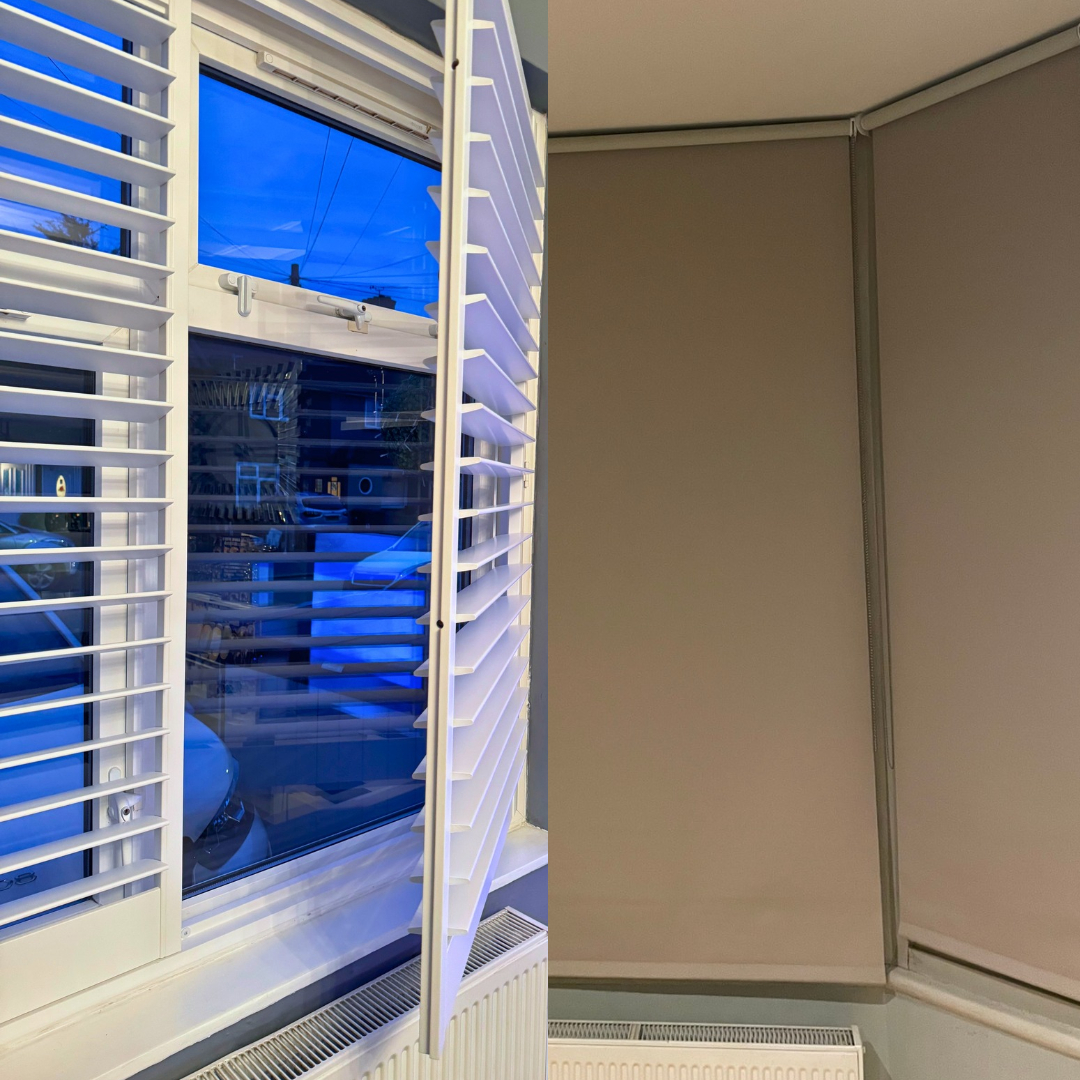
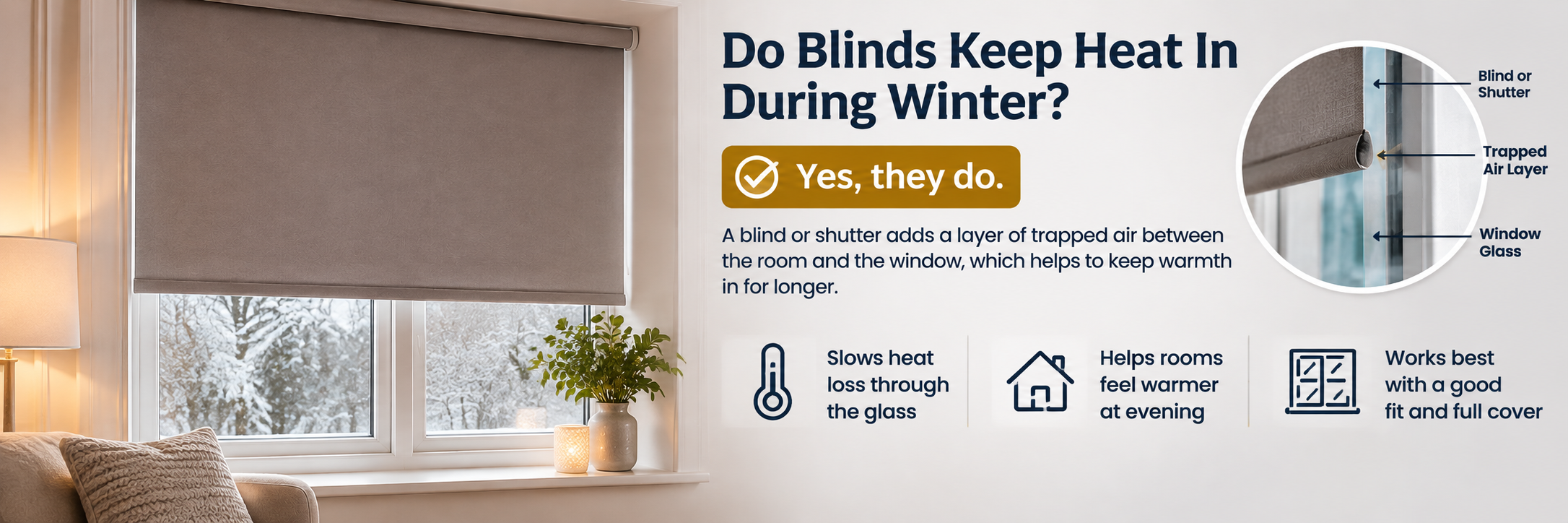
Do blinds keep heat in during winter? Yes. A blind or shutter fitted close to the glass adds a layer of trapped air between the room and the window, and that layer slows down how fast warmth escapes through what is usually the coldest surface in your home. Closed properly at dusk, blinds and shutters make a real difference to how a room feels on a cold evening. They won’t replace double glazing or draught-proofing, and we won’t pretend otherwise. As one part of a warmer home, though, they earn their place.
Do blinds keep heat in during winter, or just block light?
They do both, and the two jobs are connected. Close a blind or shutter and it sits a short distance in front of the glass, with a pocket of air trapped in that gap acting as a buffer. Warm air in the room then loses heat more slowly to the glass behind it than it would to bare glass with nothing in front of it. The same still air that keeps draughts and glare out during the day keeps a thin cushion of warmth in once the sun goes down. That’s why closing your blinds before dusk matters more than people think.
The effect depends on how well the covering fits your window as much as what it’s made from. Gaps at the sides, a short drop that leaves glass exposed at the bottom, or a loose weave that lets air move straight through will all trap far less warmth than one that closes flush against the frame.
The trapped-air principle that reduces heat loss through windows
Reducing heat loss through windows is mostly about stopping air movement, not stopping heat itself. Still air insulates. It’s a poor conductor of heat. Hold a layer of it in place between the glass and the room, and it acts a little like the air gap in double glazing, just on a much smaller scale. Moving air is the opposite. It carries heat away fast, which is why a gap at the edge of a blind undoes most of the benefit.
How well any covering holds that layer in place comes down to a few things:
- How close the fit is to the window reveal or frame, with no wide gaps at the sides
- Whether the covering reaches from the top of the window right down to the sill, with nothing left exposed
- How dense the material is, since a lined fabric or a solid louvre holds still air better than a loose, open weave
- Whether it is closed before the room starts losing heat, which in winter usually means at dusk rather than once the room already feels cold
This is the same reason a closed door keeps a room warmer than an open one. It won’t turn your single glazing into double glazing, but it does slow down a real source of heat loss.
It also explains why a short, badly fitted blind does so little. Plenty of East London terraces have a window recess that’s slightly out of square after a century of settling, so a blind ordered to a rough estimate ends up with a gap down one side. That gap lets air move in and out freely, and most of the trapped-air benefit disappears with it. Made to measure sizing matters here just as much as the material you pick.
Why rigid shutters keep more heat in than loose fabric
Shutters insulate a window better than most soft furnishings. They’re rigid. They fit into the window reveal itself, rather than hanging loose in front of it. Our full height shutters close flush across the whole window opening, with a solid frame on all four sides, so there is far less gap for air to slip around the edges. Tier on tier shutters give the same close fit but let you close just the bottom or top half, which suits a window where you want daylight at the top and warmth kept in lower down.
Do shutters keep a room warmer than curtains? In most cases, yes. A rigid shutter closes with a tighter seal than fabric. Fabric moves in a draught, or hangs away from the frame at the sides. Curtains can still help, especially a heavy, lined pair drawn properly across the whole window. It’s not always a straight choice between the two. We have compared them in more detail, including cost, cleaning and how each one looks in a period home, in our shutters versus curtains comparison.
Which keeps more heat in: shutters or lined Roman blinds?
Shutters generally hold a more consistent trapped-air layer than a fabric blind, because they close into a fixed frame rather than hanging freely. Fully lined and drawn right down to the sill with no gaps at the sides, a Roman blind still adds a genuine fabric layer of its own, and works well in a room where a shutter isn’t practical.
| Feature | Full height or tier on tier shutters | Lined Roman blind |
|---|---|---|
| Edge seal | Fixed frame closes flush against the reveal | Depends on a close, accurate fit at the sides |
| Best window shape | Recessed sash and casement windows | Most windows, including shallow recesses |
| Partial closing | Tier on tier allows top or bottom only | Usually drawn fully up or fully down |
Do lined Roman blinds help with heat loss? They do, provided the lining is reasonably dense and the blind is cut to cover the whole window rather than just the glass itself. The type of lining you choose, from a basic cotton sateen to a thicker thermal or blackout lining, makes a real difference to how much warmth it holds, and that choice deserves its own explanation rather than a rushed paragraph here. Our guide to Roman blind fold styles, linings and controls covers it properly.
Why East London’s older sash windows lose more heat
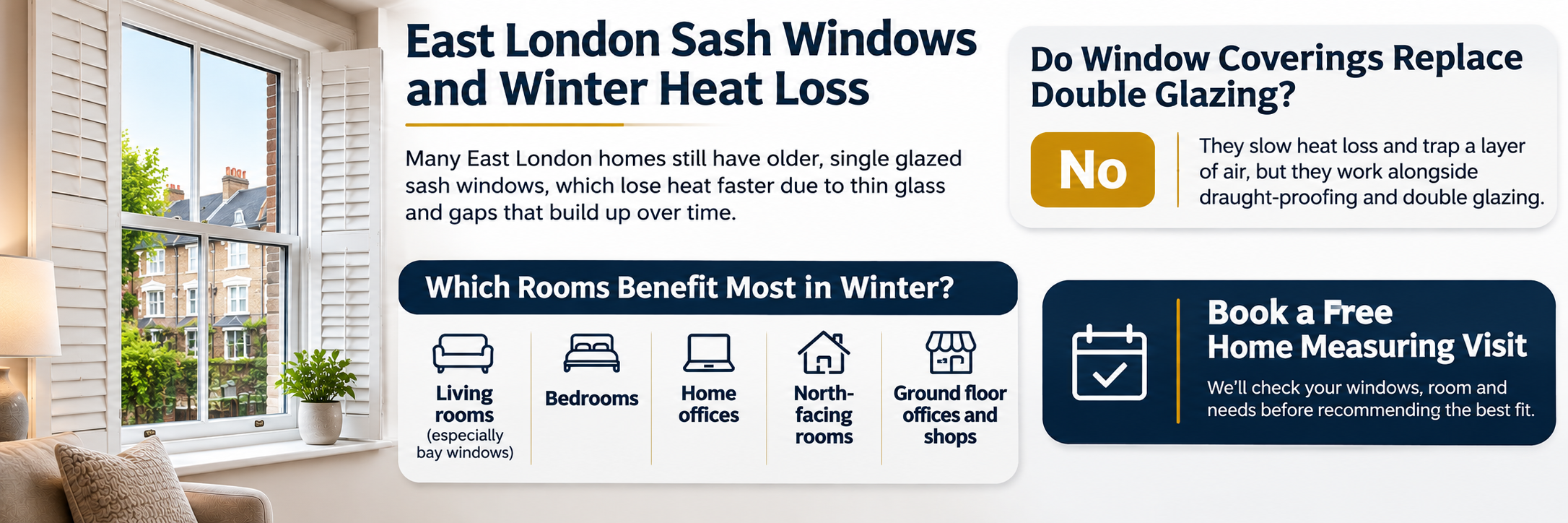
Single glazed sash windows lose heat faster than modern double glazing. Heat passes straight through the single pane of glass, and it escapes through the gaps that build up around a sliding sash over the decades. The sash sits in a box frame with moving parts. As the cords, paint and timber age, small gaps open up around the meeting rail and at the sides.
This matters more in East London than in many newer suburbs, simply because of how much older housing stock the area still has. Waltham Forest Council covers Walthamstow, Leyton and Leytonstone. It says 70% of its 107,216 homes pre-date 1944. The council runs an annual window and roof replacement programme to help improve the energy efficiency of that older housing. That scale of pre-war property is typical across much of East London more widely. It’s why so many homes here still have the original single glazed sash windows the houses were built with.
If a full window replacement isn’t on the cards yet for your home, a well-fitted covering over the sash is one of the more practical steps you can take. We fit shutters in Walthamstow regularly for exactly this reason, on the same Victorian and Edwardian sash windows the council’s figures describe.
Many of these same streets sit inside conservation areas, where planning rules often limit how much the original window frames can be changed. In that situation, replacing the glazing isn’t always straightforward or even allowed, which is exactly when a close-fitting shutter or a fully lined blind earns its keep: it works with the original sash rather than against it.
Can window coverings replace double glazing or draught-proofing?
No, and we would rather tell you that plainly than oversell a blind or a shutter. Window coverings slow down heat loss through the glass. They trap a layer of still air. But they do nothing about a draught coming through a gap in the sash, and they can’t match a sealed double glazed unit. The three jobs work together rather than instead of one another:
- Draught-proofing strips seal the gaps where a sash slides against the frame, which a blind or shutter cannot reach
- Double glazing, or secondary glazing on a window where the original frame is being kept, deals with heat passing straight through the glass
- Close-fitting shutters or a fully lined blind add a further layer on top of either of those, for the heat that still gets through
If your room still feels cold after draught-proofing and a well-fitted covering, the next place to look is the window itself, not the blind.
Which rooms benefit most from a warmer window covering in winter?
Living rooms with a large bay window benefit the most in many East London homes, simply because there is more cold glass for warm air to lose heat to, and a bay is often the room you sit in through a cold evening. Beyond the bay-fronted living room, a few other rooms are worth prioritising first:
- Bedrooms, where a warmer window near your bed makes winter evenings more comfortable without needing the heating turned up
- Home offices, which are often used in the evening or early morning when the room has had the least time to warm up
- Any room with a single glazed sash window that has not yet been draught-proofed, where the covering is doing more of the work
- North-facing rooms that get little direct sun during the day and start from a colder base in the evening
- Ground floor offices and shop units with large single glazed frontages, where a shutter closed overnight also adds a layer of security
Weighing up warmth for winter against keeping a room cooler in summer? The two goals don’t always point to the same product. If summer heat is the bigger concern in your home, we’ve written separately about what actually keeps a room cool in summer.
Not sure whether a full height shutter, a tier on tier shutter or a lined Roman blind is the better fit for a window? The easiest way to find out is to have someone measure it properly. Book a free home measuring visit and we’ll look at the window, the room and what you’re trying to fix before recommending anything.