Shutters in Isle of Dogs
Made to Measure and Fitted Free
We supply and fit made to measure window shutters for homes in Cubitt Town, Millwall and across the Isle of Dogs, with free measuring and free fitting. This page goes through the home types on the island, which shutter style suits each one, and what to check before you order.
Anyone searching for shutters on the Isle of Dogs soon finds that the island is not one kind of place. A bay-fronted terrace in Chapel House, a post-war house in Cubitt Town and a flat on a 1960s estate all have different windows, so they call for different shutters. We are London Blinds 4U, and we measure, supply and fit window shutters across London, including E14.
We start with the homes themselves. After that we look at which shutter styles fit them, what to check if you live near a conservation area or in a leasehold flat, and how we measure a bay or a flat window.
Shutters in Cubitt Town and Millwall: what the island’s homes look like
The Isle of Dogs is a peninsula in the London Borough of Tower Hamlets, postcode district E14, with the Thames bending round three sides of it. Cubitt Town, Millwall and the Canary Wharf area all sit on it. People often talk about the island as if every building were a glass tower. Much of the housing is nothing like that.
Tower Hamlets council records that Cubitt Town was developed by William Cubitt from 1842, on land leased from the Countess of Glengall. Millwall Dock opened in 1868, and by 1901 about 21,000 people lived on the island. Then came the war. The Survey of London says the damage in Cubitt Town was so heavy that most of the pre-war buildings were cleared and replaced with public housing, with building work starting early in 1952. It describes two-storey terraced houses laid out in echelons, with three-storey blocks of flats set between them.
That history matters to you for a plain reason. A lot of Cubitt Town is low-rise and post-war, so many of its windows are flat to the wall rather than period bays. Some older pockets survive, and the towers are a different story again. Each needs its own shutter answer, and the rest of this page takes them one at a time.
Full height shutters for post-war terraces and low-rise flats in Cubitt Town
A flat-fronted window is the easiest kind to fit shutters to. It has one frame, one flat wall and one reveal, which is the recess the window sits in. The shutter frame goes inside that recess and looks like part of the room.
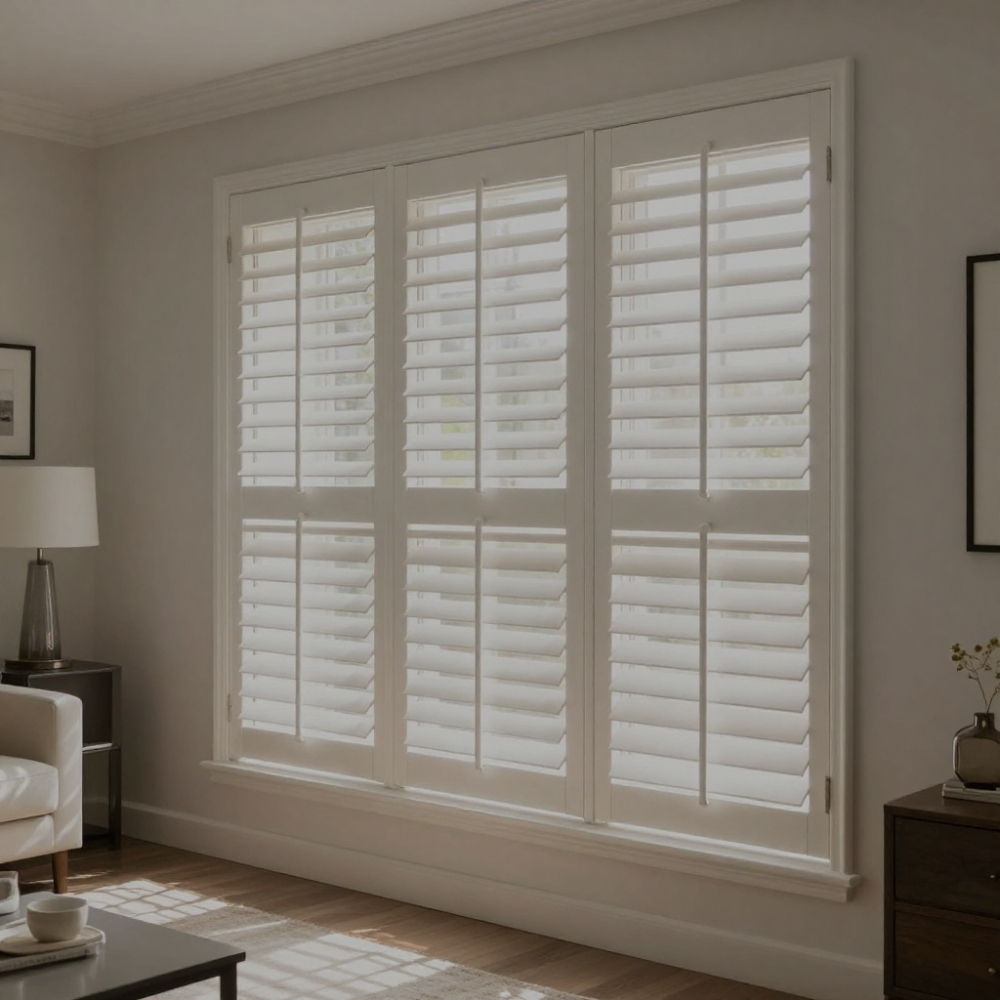
For a window like this we usually start with full height shutters. They cover the glass from sill to head in a single run of panels. On a taller window we can add a mid-rail, a horizontal bar across the panel. The louvres above the bar and below it then tilt on their own. You can close the lower half for privacy from the street and leave the upper half open for daylight.
If the window faces a path or a road and you want more control, tier on tier shutters do a similar job with two separate panels, one above the other, each with its own hinges. You can open the top pair wide and keep the bottom pair shut. Two sets of hinges mean more joinery, so it is worth asking us which of the two suits your window better.
Before we agree a style, we look at a few things. How deep is the reveal? Does a window handle or a window board sit where the frame wants to go? Is there a radiator or a sill under the window that the lower panel has to clear? A shutter can look right on a drawing and still fail on one of these. There can be technical reasons why a style does not suit a particular window, and these checks are where we find them.
Plantation shutters for the bay-fronted terrace and sash windows of Chapel House
Chapel House is the part of the island where shutters make sense on looks alone. Tower Hamlets describes Charteris Terrace on East Ferry Road, built in 1907 by Griggs and Son, as a typical bay-fronted terrace with small front gardens and tessellated tile paths. Its appraisal adds that some houses keep their original front doors and sash windows. The area became a conservation area in January 1987.
If you live in a house like that, you probably care about the windows. A sash window slides up and down, and most owners do not want to cover it or replace it. Interior plantation shutters sit inside the window reveal, so the sashes and the look of the house from the road stay as they are.
Tier on tier shutters sit well with sashes. The gap between the upper and lower shutter panels can sit level with the meeting rail, the point where the two sashes meet. The window then reads as one design.
The same conservation area has estates from 1920 to 1926 too, including the Chapel House Estate (120 properties built in 1920 to 1921) and the Manchester Grove Estate. Those homes are younger than the 1907 terrace, so their windows may well be different. We cannot tell from the street, so we look at each one.
Café style or tier on tier shutters for a bay window in Chapel House, Isle of Dogs
A bay is a group of windows set at angles. Most are canted bays, with a flat centre window and an angled window on each side. Shutters in a bay are made as separate panel sets, one for each section, so the whole run can fold back when you want the view.
You have three sensible choices. Full height with a mid-rail gives one clean line and good control over each half. Tier on tier lets you open the top panels and keep the bottom ones closed. Café style shutters cover only the lower part of the window, from the sill upwards, so the top of the glass stays open to daylight.
The right one depends on how overlooked you are, how much light the room needs and how your sashes work. We talk it through at the window, with the bay in front of us.
Shutters in Island Gardens and Coldharbour: checking the conservation area rules
Tower Hamlets says every one of its conservation areas has an adopted character appraisal and management guidelines. On the island those include Island Gardens (designated in March 1971), Coldharbour (December 1975) and Chapel House (January 1987).
The Island Gardens appraisal covers the Greenwich Foot Tunnel rotunda and several listed buildings, among them the Church of Christ and St John, The Watermans Arms and the Ferry House pub. It says most of the homes inside the area were built in the late 1970s and early 1980s. A riverside villa at 58 to 60 Ferry Street dates from 1830 to 1850. Coldharbour includes Bridge House (1819 to 1820) and Isle House (1825 to 1826), the old dock officials’ houses, which have full-height bow windows.
What does that mean if you want shutters? Conservation area controls mostly deal with changes to the outside of a building. Interior shutters sit inside the window reveal, which is a different matter. Even so, the rules differ from home to home, and the council has the final word. Planning Portal says that if you live in a listed building you will need listed building consent for any major works, inside or out. So if your home is listed, speak to the council before you order anything.
For a house, a short call or email to the Tower Hamlets planning team will settle it. If you own or rent a flat, your freeholder or managing agent is the person to ask. We are happy to look at the windows with you, but the answer on consent has to come from the council or your freeholder. Our guide to shutters explains the style options in more detail.
Shutters for estate flats in Millwall and Cubitt Town: lease, landlord and managing agent checks
Plenty of people on the island live in flats. The Samuda Estate was built in 1967, with four and six-storey blocks and Kelson House, a 25-storey tower of interlocking maisonettes by the river. The Barkantine Estate in Millwall opened its first block in 1968 and originally had 634 dwellings. Cubitt Town also has three-storey blocks of post-war flats set between the terraces.
If you own a flat on a lease, read it before you order. Some leases limit what you can change at a window, and some blocks like windows to look the same from the street. Shutters show through the glass, so it is fair to ask your managing agent if that matters in your block. A shutter fitted inside the reveal is a smaller change than anything on the outside, but the lease is what counts.
If you rent, ask your landlord in writing. Shutters are screwed into the frame or the wall around the window, so there will be fixing holes if they ever come out.
When a block repeats the same window on every floor, we still measure each one. Walls and reveals vary a little, even in the same building, and a made to measure shutter has no spare room to hide the difference.
Which shutters suit which Isle of Dogs home? A table of styles and limits
| Home on the island | Shutter style to ask about | Limit to know about |
|---|---|---|
| Post-war terrace house in Cubitt Town | Full height shutters, or tier on tier for a street-facing room | Reveal depth, handles, radiators and sills all need checking |
| Three-storey low-rise flat | Full height or café style shutters | Lease, landlord or managing agent may have a say |
| Bay-fronted terrace in Chapel House | Tier on tier, or full height with a mid-rail, made in sets for each bay section | Each bay section is measured on its own, and bays are not always square |
| Home with original sash windows | Tier on tier shutters, split to meet the sash division | The shutter sits inside the reveal, so check the depth is enough |
| House inside the Island Gardens or Coldharbour conservation areas | Interior shutters, in the style that suits the window | Ask Tower Hamlets council first, and more so if the building is listed |
| 1960s estate flat or maisonette | Full height shutters on standard windows, sliding or folding shutters on balcony or patio doors | Leasehold and block rules, and a sliding track needs room to run |
| Tower flat with floor-to-ceiling glass | Folding or sliding shutters for glass doors, blinds for the tallest panes | Full shutters may not suit very tall glazing, and we will say so at the visit |
Measuring for shutters on the Isle of Dogs: a worked example for a bay and a flat window
This is an example of how we measure, with made-up figures to show the method. It is not a record of a past job.
Take a bay with three sections. We measure each section on its own. For the left section we take the width at the top, the middle and the bottom, then the height down the left side, the middle and the right side. Say the widths read 842, 846 and 851 mm. Walls are rarely perfect, so the three numbers differ. We note all of them and work from the smallest. A panel can be made to sit snug, but it cannot be squeezed into a gap that is too narrow.
Next comes the angle where two sections meet. Not every bay is cut at the same angle, and the hinges between the panel sets have to match it. We also measure the depth of the reveal, because the frame needs room, and we check what already sits in the recess, such as a window board, a handle or a lip of the frame. Then we do the same for the centre and right sections.
A flat window is simpler but gets the same care. Three widths, three heights, one depth reading, and a look at what is beneath and beside the window. If a radiator sits under the sill, we plan the lower panel so it clears the heat and the pipes. If the window is close to a corner, we check that the panels can open fully and not hit the wall.
The result is a set of figures for each section, a note of any awkward spots and a style we think suits the window. You see all of it at your window, so the quote holds no surprises.

Window Shutters London
We understand that your London home or business is your pride and joy – a place that reflects your style, personality and design aesthetic. If you are looking to add style and elegance to your windows, shutters are a great alternative to blinds or curtains. Not only do wooden window shutters provide additional privacy, but are also energy efficient, keeping you warm in the winter and cool in the summer.
Shutters London
Why Choose London Blinds 4U for Window Shutters?
– Great Quality
– Made to Measure
– Excellent Customer Service
– Competitive Quotes
– Hassle Free
– Multiple Styles Available
– Free Measuring & Fitting

“They measured my windows first and then 4 weeks after they fitted my blinds and shutters. I would not hesitate to recommend this company to anyone.”
- Liza Harrison
Plantation Shutters London Styles
When considering new shutters in your home or business premises, you must consider the style of building, the room you are looking to install wooden plantation shutters in, and the style you are interested in. Customers should also think about the purpose of the shutters – different styles are better for those looking for optimal privacy, while others allow more light to flood the room. We are equipped with all the knowledge you need to make a perfect choice.
There are many different types of shutters available for your London home or business – picking the right design is key to your comfort and style! We stock many styles of bespoke shutters:

Tier on Tier Shutters London
This type of shutter is basically one shutter fixed above another shutter, giving you the option of controlling the slats individually. For example, you may wish to close the bottom half slats for privacy but keep the top tier slats open to allow light into the room. Tier on Tier Shutters offer flexibility for varied use.
Full Height Shutters London
Full height is the most common type of shutter you may come across day to day. Full height shutters cover the whole of the window. Various options available for full height shutters, one being the option of having a mid-rail. Mid-rails are added to full height shutters for taller windows to strengthen the shutter; they also allow you to operate the upper and lower slats individually, giving you maximum light and privacy control for your London property.
Café Style Window Shutters London
This type of shutter is normally fitted at half height from the window sill upwards. Café style shutters, as the name suggests, are commonly used in restaurants and other catering environments. However, they are also suited for use in homes; the great benefit of these shutters is that they let plenty of light into any room but provide privacy from the base where the shutter is fitted.
Folding Shutters and Sliding Shutters London
For big glass windows, such as French doors and patio doors, sliding or folding shutters on tracked systems are a wise choice. These shutters are easily folded back to one side for practicality and ease of access through doorways or sliding doors. We stock a large variety of plantation shutters in different materials, patterns and colours to ensure our customers always purchase the best design for their individual needs.
Fitting Bespoke Window Shutters in London
Book an appointment today with one of our experienced advisors and we will advise you on what is the best type of shutter for your windows. We use no sales techniques, just straightforward guidance and realistic price quotes.
We offer a free onsite visit and go through the different types of shutters available with you. We can also match Wooden Venetian blinds to complement the shutters for those awkward windows to which shutters cannot be fitted.
Our wooden shutters are made from high-quality basswood and are also available in PVC (faux wood) for increased strength. This option is also more environmentally friendly. All our London shutters are available in various slat sizes, including 47mm, 63mm, 89mm & 114mm. LondonBlinds4U shutters are available in various finishes including whites, off-whites and various wood finishes.
Ask us about our full range, or book an appointment today with one of our experienced advisors!

“Excellent service with two lovely men who did a great job! Thank you!”
- Google review
Basswood or PVC shutters on the Isle of Dogs: choosing the material and louvre size
Two materials come up most. Basswood is a real wood, with a light, smooth grain that takes paint and stain well. PVC, sometimes called faux wood, is made to stand up to damp. For a kitchen or bathroom, and for any room that steams up, PVC is the safer choice. For a living room or bedroom, either works, and it comes down to the look you want and what you are willing to spend.
The louvres are the slats that tilt open and shut. We offer four sizes: 47, 63, 89 and 114 mm. A smaller louvre suits a small window and gives a more traditional look. A wider louvre shows fewer slats and gives a clearer view when it is open. A tall bay in a Chapel House terrace can carry a bigger louvre. A narrow window in a low-rise flat might look better with a smaller one.
Finish is the other choice. White and off-white are the usual picks, and we also offer natural wood tones, patterned finishes and custom colours. It helps to think about the colour of your walls and how much sun the room gets.
Plantation shutters and young children: what to check in an Isle of Dogs home
If you have babies or toddlers at home, the operating mechanism matters. The British standard BS EN 13120 applies to plantation shutters. On most full height and tier on tier shutters, the tilt mechanism that moves the louvres is cord free. Some sliding, bi-fold and café style set-ups do use a cord or chain, depending on the product.
So do not assume. Ask us which mechanism your shutters will have, and tell us if a child sleeps or plays near the window. Our guide to how plantation shutters meet child safety rules sets out what the standard says about loops and heights, so you know what to look for.
Shutters on the Isle of Dogs or blinds: which one for which window
Shutters are at their best on a window with a proper reveal, where you want privacy and daylight at the same time. You tilt the louvres and the room changes. They also last a long time with basic care, and they look like part of the house.
They are not the answer to everything. Shutters are not a blackout, because a thin line of light can show round the frame and between the louvres. For a bedroom where you want it dark, blinds can do that job better. Very wide or very tall glass is another case where blinds can suit better. In a tower flat with floor-to-ceiling glazing, full shutters often do not work, and we would rather say so than sell you the wrong thing. Our page on blinds for Canary Wharf and the Isle of Dogs covers that side of the island, and it is a good read if your home is in one of the big blocks.
If you are weighing the two up for an ordinary house or flat, our comparison of shutters or blinds, and what each costs goes into more detail. We fit both, so we have no reason to push you either way. Some homes end up with shutters on the front windows and blinds somewhere else, and that is fine.
Café style and sliding shutters for ground floor windows and patio doors on the Isle of Dogs
A ground floor window on a street or a path brings the privacy question straight away. Café style shutters cover only the bottom half of the window, from the sill up. People walking past cannot see in, but the top half of the glass stays clear, so daylight still pours in. They work well in a kitchen, a front room or a dining room at street level. In a kitchen or bathroom, ask for PVC.
Patio doors, balcony doors and wide glass need a different approach. A hinged panel that big would swing out into the room. Sliding and folding shutters run on a track instead, so they glide along or fold back to the side. The track needs a clear run, so we check the space either side of the door.
As noted above, some café style, sliding and bi-fold set-ups use a cord or chain. If a small child lives with you, ask which one you are getting before you decide.
What happens at a free shutters measuring visit on the Isle of Dogs
You tell us which rooms you have in mind, and we book a time to come to you. The measuring is free, the fitting is free, and there is no call-out charge. We also give a free on-site quotation. Our quotes are non-binding, so you can think it over after we leave.
At your windows we do four things. We measure every window as described above. We look at the reveal, the sills, the handles and anything in the way. We talk you through louvre sizes and finishes, with your own light and walls in mind. And we tell you which styles will work and which will not. We do not use sales techniques. You get plain advice and a realistic quote, and you decide.
If you live in a block with controlled access, let us know when you book so we can plan around it. The same goes if you rent and need your landlord’s agreement first. We would rather fit the visit round that than turn up and find we cannot get in.
Our customer reviews page shows what people say after the fitting. A Google review from Nadia m reads: “Very happy with our new shutters. Beautifully fitted and very good quality.”
Isle of Dogs shutters questions we get asked
Q: How long do plantation shutters last in an Isle of Dogs home?
Our own comparison guide puts the life of shutters at twenty years or more with basic care. Blinds tend to need replacing sooner. A good clean now and then, and a gentle hand on the louvres, is most of what it takes.
Q: How do I clean shutters in an Isle of Dogs home?
Dust them with a soft cloth or a soft duster, closing the louvres and wiping along each slat, then tilting them the other way to do the other side. For marks, use a slightly damp cloth and dry it straight away. With basswood, keep water to a minimum. PVC shutters cope with a damp wipe better.
Q: Do shutters make an Isle of Dogs room darker?
Only when you want them to. With the louvres open the light comes through. Closed, they cut glare and give privacy, but a little light can still show round the edges. If you want a pitch-dark bedroom, tell us at the visit and we will talk through the options.
Q: Can I still open my window with shutters fitted on the Isle of Dogs?
Yes. The shutter panels open like small doors, on their hinges, so you swing them clear and then open the window. With sash windows, you open the panels and lift the sash as before. We check the way your window opens before we settle the style.
Q: Do shutters cut noise in an Isle of Dogs flat?
They can take the edge off, especially full height shutters kept closed, but they are not soundproofing. Our guide on whether shutters cut noise explains what to expect, and what really helps.
Q: Can window shutters be fitted to uPVC windows on the Isle of Dogs?
Usually, yes. The shutter frame is fixed to the reveal or to a surround around the window, not to the glass. What matters is what the frame can be screwed into, and we check that when we measure.
Q: Do shutters help keep an Isle of Dogs flat warm or cool?
They help. A closed shutter adds a layer between the room and the glass, which cuts draughts in winter and takes the heat out of strong sun in summer. They do not replace good glazing or heating, but they make a difference you can feel.
Book free shutters measuring on the Isle of Dogs
Our base is in Dagenham, and we come to you on the island for the measuring visit. Call us on 07852 257 307 or write to info@londonblinds4u.co.uk, and tell us which rooms and windows you have in mind. We are open Monday to Saturday from 9am to 9pm, and on Sunday from 10am to 6pm.
Prefer to send details in writing? Use our contact page to ask for a free measuring visit. Measuring is free, fitting is free, and the quote that follows does not tie you to anything.