Shutters in Docklands
Wapping and Limehouse Warehouses, Terraces and Riverside Flats
Shutters in Docklands start with the building: a converted Wapping warehouse, an 1811 terrace and a Limehouse flat behind old loading doors each need different checks before you order. We supply and fit made to measure shutters here, measure for free, and tell you which styles suit each window and what to ask the council or your landlord first.
We cover Docklands, including Wapping and Limehouse streets, and we supply and fit made to measure shutters across London with free measuring and free fitting. Towers are another matter. For those, see our pages on shutters in Canary Wharf and shutters on the Isle of Dogs.
Which Wapping or Limehouse building are your Docklands shutters going into?
Pick the description closest to your home, because the building decides which check comes first. If two fit, read both sections.
- A converted warehouse flat. Test: are your windows made of small panes in thin iron frames, or set in a deep recess with a stone or metal bar down the middle? Read the warehouse sections.
- A Georgian terrace house. Test: is it a brick house of three storeys over a basement, with sash windows and thin glazing bars, and curved tops to the ground-floor windows? Read the Pierhead section.
- A low terrace near the river. Test: is the house two to four storeys, with a front window close to the pavement? Read the Narrow Street terrace section.
- A flat above a business, or in a newer riverside block. Test: do you share a staircase with a shop, pub or office, or does a managing agent run the building? Start with the ownership checklist.
Listed building consent and shutters in Wapping and Limehouse: what to ask the council
Ask Tower Hamlets before you order. Wapping Wall’s appraisal sets strict limits on work and does not mention shutters either way. On Wapping Wall, the appraisal says: “Before carrying out any work in this area, you will need to apply for consent even for minor work such as replacing railings.” Shutters are not railings, so that line does not answer your question. It does show how careful the council wants people to be.
If your building is listed, take consent seriously. Tower Hamlets says listed buildings need “listed building consent” if you “alter a listed building, either internally or externally”, and it calls unauthorised change a criminal offence. It adds that for listed buildings “all parts of the building, including its interior walls, ceilings and all other internal features, are protected”. So we never say shutters need no consent. Whether a shutter fixed inside a listed flat counts as an alteration is for the council to say.
All three appraisals, for Wapping Wall, Wapping Pierhead and Narrow Street, also say the council will consider Article 4 Directions, which take away some building work you could normally do without applying. None is confirmed in those papers, so we cannot say whether one covers your street. Put three questions to the council in writing and keep the reply.
- Is my building listed, and at what grade?
- Is my street in a conservation area, and does an Article 4 Direction apply?
- If interior shutters are fixed to the window frame or the reveal, do I need consent?
Shutters for a converted Wapping warehouse flat: small panes, iron frames and deep recesses
Shutters can suit a warehouse flat, but the frame and the recess decide the style, so we look at both first. Wapping Wall’s appraisal describes “a river-face of substantial 19th century warehouses on brick wharves” and says the empty buildings were converted to homes, leaving the area “almost entirely residential” with a few small commercial uses at street level.
These windows are not like the ones in a 1930s semi. Historic England’s list entry for Metropolitan Wharf on Wapping Wall describes “iron framed small pane glazing”, segmental arches and “glazed and panelled hatches”. Its entry for Oliver’s Wharf on Wapping High Street describes three-light windows with stone mullions and lower windows in shallow arched recesses. A mullion is an upright bar that divides a window into lights. Those are two listed buildings, not a rule for every flat. They show what a warehouse window can include.
Plain tests for small-pane, iron-framed Wapping windows before we measure for shutters
You can do all of this with a phone and a tape measure, and your answers help us come prepared.
- Measure the recess depth, glass to wall face, in three places. If the figures differ, tell us.
- Look for a mullion or an iron bar through the middle. Panels may need to sit either side of it.
- Check handles, stays and catches. Anything that sticks into the recess can stop a panel closing.
- Note whether the window opens in, out or not at all, and whether it is a hatch.
- Look under the sill for a radiator or pipes. They limit how far a panel can swing.
- Think about scale. Narrower louvres can sit better against small panes, and we supply 47, 63, 89 and 114 mm.
Deep recesses in Wapping warehouse flats and how we measure them for shutters
A deep recess is a plus, because the shutter can sit fully inside and leave the room clear. It needs careful measuring, because old brick walls are rarely square. Our guide to how recess measuring works explains recess and outside-recess fits, and the same ideas apply to shutters. Do not order from your own figures. We measure for free.
Shutters for loading-door glazing and cast iron windows on Narrow Street, Limehouse
Full height openings are where shutters earn their place on Narrow Street, because one tall window can carry a large share of a room’s light. For Narrow Street, the appraisal says the warehouses’ “original loading doors and cast iron windows are preserved” and calls them examples of successful conversion to homes. It describes them as up to three storeys high and only a few bays wide.
With few bays across the front, each window matters. Tilting louvres let you steer the light instead of blocking it. Full height shutters run from sill to head, usually with a mid-rail, a horizontal bar that lets the upper and lower louvres tilt separately. For a former loading door, work through these before you pick a style.
- Floor space: a swinging panel needs clear floor in front of it.
- The handle: does it stand proud of the glass?
- Whether you walk through the opening. If you do, sliding and folding shutters run on a track and need no swing space. They do need room at the side.
- The frame itself: we must see where a shutter frame can be fixed on cast iron, to the reveal or elsewhere.

Window Shutters London
We understand that your London home or business is your pride and joy – a place that reflects your style, personality and design aesthetic. If you are looking to add style and elegance to your windows, shutters are a great alternative to blinds or curtains. Not only do wooden window shutters provide additional privacy, but are also energy efficient, keeping you warm in the winter and cool in the summer.
Shutters London
Why Choose London Blinds 4U for Window Shutters?
– Great Quality
– Made to Measure
– Excellent Customer Service
– Competitive Quotes
– Hassle Free
– Multiple Styles Available
– Free Measuring & Fitting

“They measured my windows first and then 4 weeks after they fitted my blinds and shutters. I would not hesitate to recommend this company to anyone.”
- Liza Harrison
Plantation Shutters London Styles
When considering new shutters in your home or business premises, you must consider the style of building, the room you are looking to install wooden plantation shutters in, and the style you are interested in. Customers should also think about the purpose of the shutters – different styles are better for those looking for optimal privacy, while others allow more light to flood the room. We are equipped with all the knowledge you need to make a perfect choice.
There are many different types of shutters available for your London home or business – picking the right design is key to your comfort and style! We stock many styles of bespoke shutters:

Tier on Tier Shutters London
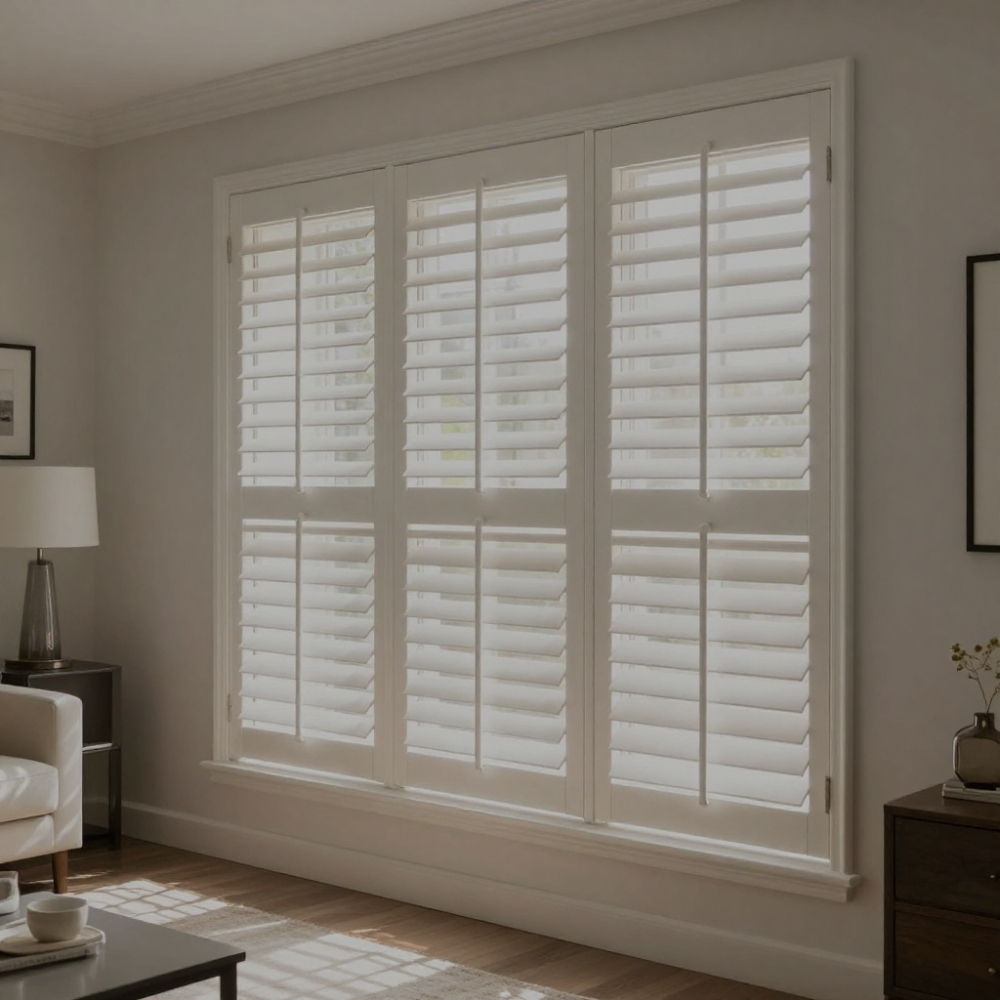
This type of shutter is basically one shutter fixed above another shutter, giving you the option of controlling the slats individually. For example, you may wish to close the bottom half slats for privacy but keep the top tier slats open to allow light into the room. Tier on Tier Shutters offer flexibility for varied use.
Full Height Shutters London
Full height is the most common type of shutter you may come across day to day. Full height shutters cover the whole of the window. Various options available for full height shutters, one being the option of having a mid-rail. Mid-rails are added to full height shutters for taller windows to strengthen the shutter; they also allow you to operate the upper and lower slats individually, giving you maximum light and privacy control for your London property.
Café Style Window Shutters London
This type of shutter is normally fitted at half height from the window sill upwards. Café style shutters, as the name suggests, are commonly used in restaurants and other catering environments. However, they are also suited for use in homes; the great benefit of these shutters is that they let plenty of light into any room but provide privacy from the base where the shutter is fitted.
Folding Shutters and Sliding Shutters London
For big glass windows, such as French doors and patio doors, sliding or folding shutters on tracked systems are a wise choice. These shutters are easily folded back to one side for practicality and ease of access through doorways or sliding doors. We stock a large variety of plantation shutters in different materials, patterns and colours to ensure our customers always purchase the best design for their individual needs.
Fitting Bespoke Window Shutters in London
Book an appointment today with one of our experienced advisors and we will advise you on what is the best type of shutter for your windows. We use no sales techniques, just straightforward guidance and realistic price quotes.
We offer a free onsite visit and go through the different types of shutters available with you. We can also match Wooden Venetian blinds to complement the shutters for those awkward windows to which shutters cannot be fitted.
Our wooden shutters are made from high-quality basswood and are also available in PVC (faux wood) for increased strength. This option is also more environmentally friendly. All our London shutters are available in various slat sizes, including 47mm, 63mm, 89mm & 114mm. LondonBlinds4U shutters are available in various finishes including whites, off-whites and various wood finishes.
Ask us about our full range, or book an appointment today with one of our experienced advisors!

“Excellent service with two lovely men who did a great job! Thank you!”
- Google review
Shutters for an 1811 Wapping Pierhead terrace: sash windows and round arches
A Georgian terrace house at Wapping Pierhead can take shutters, but arched windows need to be seen before we suggest a style. Historic England’s list entry for Nos 5 to 10 describes the houses as three storeys and a basement, “all sashes with glazing bars”, and ground-floor windows that are “round arched, recessed and set in wider brick arches”. It lists them as Grade II, so the consent questions above come first.
A sash window has two frames that slide up and down. Glazing bars are the thin bars between panes. A shutter must clear both, and the lower sash has to stay usable if you want to open it.
Round-arched recessed windows in Wapping: what we check for shutters at the measuring visit
- The head: fully round, or flat with an arch above?
- Recess depth at the sides and at the top.
- Whether the lower sash lifts, and how far.
- Where the sash cords, catches and lifts sit.
- Whether the opening is square at the sill, where a shutter frame would rest.
Tier on tier or full height shutters for a Pierhead sash, and a word on children
Tier on tier shutters are two panels, one above the other. You can close the lower half for privacy and leave the upper half open. On a tall sash, the split can sit near the meeting rail, where the two sashes overlap, though we check that rather than assume it. Our guide to full height or tier on tier explains how each is built and used.
In a family house, ask which tilt mechanism your shutters use. The usual louvre tilt on most full height and tier on tier shutters has no cord. Some sliding, folding or café set-ups use a cord or chain, depending on the product. Our page on how shutters meet BS EN 13120 covers the standard.
Shutters for a low Narrow Street terrace: pavement privacy and river light
Low terraces suit tier on tier, because the closed lower panels give privacy while the open upper panels keep the daylight. Narrow Street’s appraisal says the historic terraces are between two and four storeys and “one of the few surviving examples” of a Limehouse dwelling type. A front window on a low terrace can sit close to the pavement, so people walking past can see in.
- Stand in the room at the time of day you use it most.
- Note where the sun lands and whether it is in your eyes or on a screen.
- Look out for passers-by at eye level, and note which panes they can see through.
- Tell us. It affects the louvre size and the style you will be happiest with.
Who can say yes to shutters in a Wapping flat above a business or in a riverside block?
Whoever your lease or tenancy names, and you need their answer in writing before you order. Wapping Wall’s appraisal says a few small commercial uses remain at street level, so some homes share a building with a shop or an office. Narrow Street’s appraisal describes newer residential developments along the river edge. A flat above a business may have a freeholder and a managing agent who treat the window frame as part of the structure, and a newer block has house rules of its own. Work through this list in order.
- Read your lease for the words alterations, windows and structure. Note what it says about anything fixed to the frame.
- Find out whether the frame is yours or the freeholder’s. In some leases the flat stops at the inside face of the glass.
- Ask the managing agent in writing. Say you plan to fit shutters, in which rooms, and that they are fixed to the frame or the reveal.
- Ask whether the building is listed and whether the freeholder has dealt with the council about it.
- If you rent, ask your landlord whether shutters can go in, and whether they should stay or come down when you leave.
- Keep every reply with the quotation we give you.
Shutters for Docklands warehouse, terrace and flat windows at a glance
| Window | Style to look at first | What we check |
|---|---|---|
| Iron-framed small panes | Full height or tier on tier | Handles, frame depth, fixing points |
| Deep recess with a mullion | Full height set in the recess | Depth at three points, bar position |
| Tall former loading door | Full height or sliding | Floor clearance, handle, side space |
| Georgian sash with bars | Tier on tier | Meeting rail, whether the sash lifts |
| Round-arched recessed window | Decided at the visit | Shape of the head, recess depth |
When a Wapping or Limehouse window suits blinds better than shutters
Some windows here are better with blinds, and we will say so at the visit. These are the usual cases.
- A shallow or crowded recess with little room for a frame.
- A door you pass through all day.
- A small kitchen window where you want a fabric finish.
Our comparison of shutters or blinds sets out the difference. It puts shutters at roughly two to four times the cost of a comparable blind per window, with a life of twenty years or more with basic care against five to ten for blinds. That is a guide to how they compare, not a price for your windows. Some homes mix both: shutters at the front, blinds at the back.
What to have ready for a free shutters measuring visit in Wapping or Limehouse
A few things save time on the day, and none takes long.
- A photo of each window from across the room, with the whole recess in shot.
- A close photo of any handle, catch or hatch on the frame.
- The name of your landlord, freeholder or managing agent, and any reply you have had.
- A note of any listed status or council advice you have been given.
- The rooms you care about most, and whether privacy or light is the bigger worry.
Book free shutters measuring in Wapping and Limehouse
Call us on 07852 257 307 or email info@londonblinds4u.co.uk. We answer Monday to Saturday from 9am to 9pm and on Sunday from 10am to 6pm. If you would rather send your details, the contact page has a form for booking a free measuring visit.
Questions about shutters in Wapping and Limehouse windows
Q: Can shutters be fitted to cast iron windows in Wapping?
Sometimes, but it depends on where a frame can be fixed. We look at the iron, the reveal and the wall around it at the visit, then say whether a shutter can be fitted and which style suits. If a style will not suit, you hear it before you order.
Q: Do shutters look right on small-pane windows in a Docklands warehouse?
They can, if the louvre size and style are chosen with the panes in mind. Louvres of 47 or 63 mm can look in scale with small panes, while wider ones give a clearer view. We hold the sizes against your own window and you choose.
Q: What will shutters look like from the street in Wapping?
From the street you see the back of the panels behind the glass. Whether that suits the building is taste, and for a listed or conservation area property the council may have a view. Ask them before you order.
Q: Can you measure my Wapping windows for shutters in the evening or at the weekend?
Call or message us and say what suits you. Our phone lines are open until 9pm Monday to Saturday and until 6pm on Sunday, and we arrange the visit with you.
Q: Should every window in a Wapping terrace row have matching shutters?
For windows that face the street, a matching style and louvre size keeps the house looking like one design. At the back you have more freedom. We can talk through front and rear windows together.